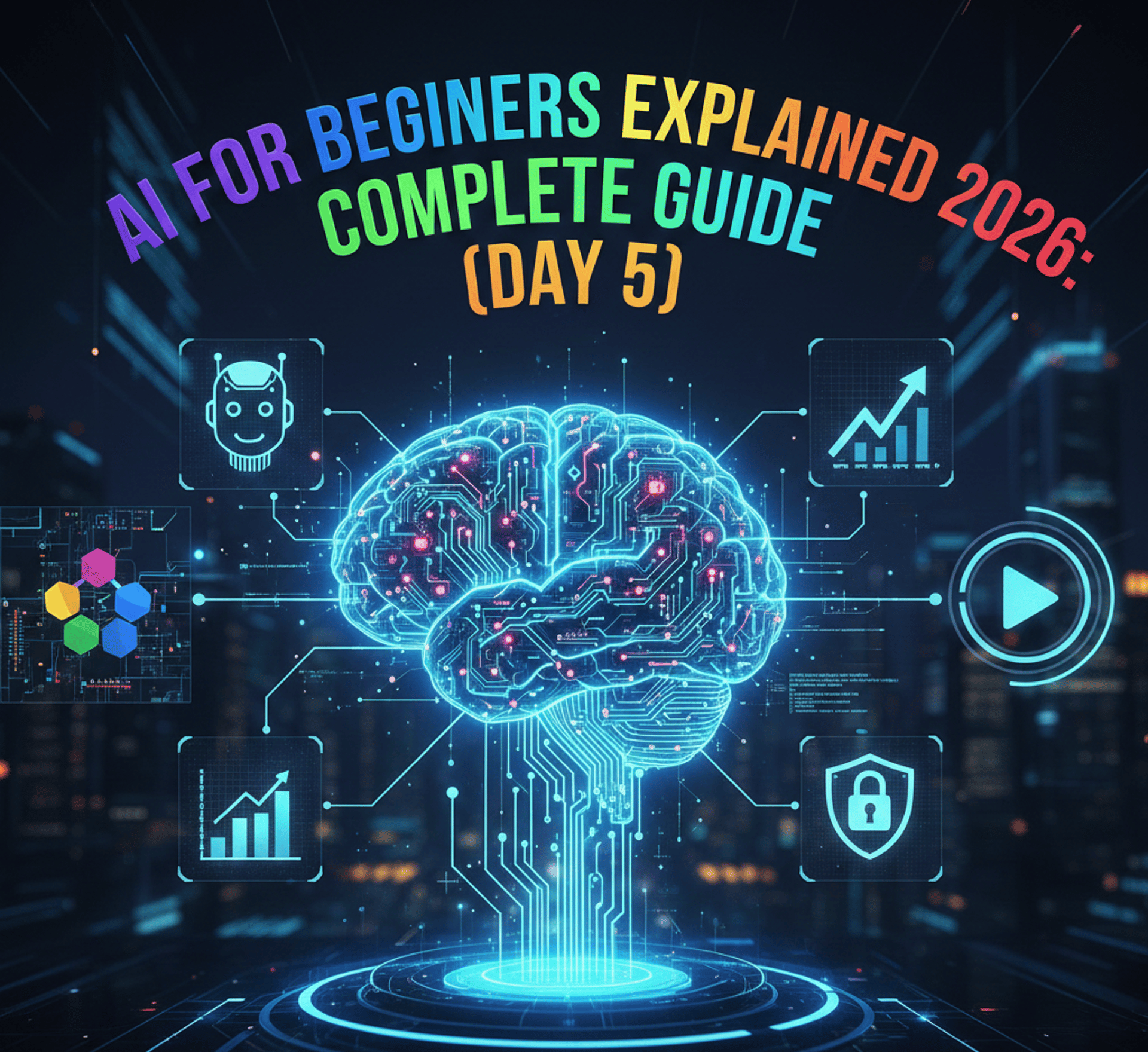
AI for Beginners Explained 2026: Complete Guide
AI for beginners explained 2026 made simple. Learn how AI agents work, key tools, ethics, and real-world uses in this clear, beginner-friendly master guide.
TECHNOLOGYBEST AI TOOLS FOR BUSINESS AUTOMATION ROADMAP 2026
The TAS Editorial Team
1/21/20265 min read
Day 5: The 2026 Master Guide – State of the Union
Focus Topic: Generative AI, Agents, and the 2026 Landscape
Artificial Intelligence is no longer a future promise—it is the present operating system of the digital world. In 2026, AI has quietly shifted from being a tool you use to a partner that acts. For beginners, this change can feel overwhelming. Buzzwords like agents, copilots, multimodal models, regulation, and ethics are everywhere.
This guide is written for clarity—not hype.
Welcome to Day 5 of The TAS Vibe’s 2026 Master Series, where we break down the real state of AI today, explain what matters, and show beginners exactly how to understand—and benefit from—the AI-powered world.
Whether you are a student, creator, marketer, solopreneur, or simply curious, this article is your AI for beginners full guide 2026—written in plain English, backed by real-world relevance, and optimized for how Google understands helpful content in 2026.
Watch this quick video for an overview before reading.
🎧 Prefer listening? Play the audio version below.
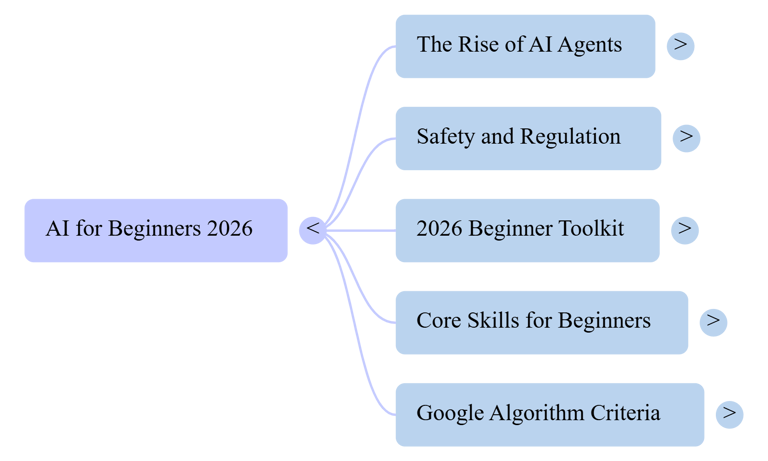
This mind map gives you a quick overview of the concepts covered below.
The Rise of AI Agents – Moving from “Search” to “Action”


From Asking Questions to Delegating Work
In the early 2020s, AI was mainly about search and answers. You typed a question, and the AI responded.
In 2026, that era is over.
Today’s AI systems are agents—software entities that don’t just respond, but act on your behalf.
An AI agent can:
Research a topic
Compare options
Make decisions based on rules
Execute tasks across apps
Learn from outcomes
Instead of asking “What should I do?”, users now say:
“Do this for me, and report back.”
This shift—from search to action—is the single most important AI trend beginners must understand in 2026.
What Exactly Is an AI Agent?
An AI agent is a system that combines:
Reasoning (understanding goals)
Memory (learning from past interactions)
Tools (access to apps, APIs, and platforms)
Autonomy (ability to take steps without constant input)
Think of it as a digital assistant that doesn’t wait for instructions every second.
Real-world examples beginners already use:
Email agents that prioritize, summarize, and draft replies
SEO agents that audit content and suggest optimizations
Shopping agents that track prices and auto-purchase
Study agents that create revision plans and quizzes
You may not call them “agents”—but you are already using them.
Why This Matters for Beginners
For beginners, AI agents lower the skill barrier.
You no longer need to:
Learn complex software
Write code
Understand technical workflows
Instead, you need to learn how to communicate goals clearly.
In 2026, the most valuable skill is not typing faster—it’s thinking better.
This is why we strongly recommend reading our next lesson:
👉 Interlink: Day 6: No Coding Required – Mastering AI Concepts
That guide shows how beginners can control AI using logic, structure, and intent—without writing a single line of code.
Safety & Ethics – How the US, Europe, and Russia Are Regulating the Vibe


AI’s rapid growth forced governments to act. By 2026, regulation is no longer optional—it is foundational.
But here’s the key insight:
Regulation is not killing AI innovation—it’s shaping trust.
Let’s break it down by region.
United States – Innovation First, Accountability Second
The US approach to AI regulation focuses on:
Encouraging innovation
Holding companies accountable for misuse
Sector-based rules (healthcare, finance, education)
Instead of one massive AI law, America uses guidelines, executive frameworks, and industry standards.
For beginners, this means:
AI tools remain widely accessible
Content creators can monetize AI-driven work
Platforms must label AI-generated content
Transparency is the keyword in the US.
Europe – Human Rights and Trust at the Core
Europe takes a more structured approach.
By 2026, the EU’s AI frameworks emphasize:
Risk classification (low, medium, high risk AI)
Data privacy and consent
Clear disclosure when AI is involved
For users in Europe:
You’ll see more AI labels
Safer consumer protections
Slower rollout—but higher trust
Europe’s goal is simple: AI must serve humans, not replace responsibility.
Russia – Strategic Control and National AI Development
Russia’s AI regulation focuses on:
Sovereign AI infrastructure
Domestic data usage
State-guided innovation
For beginners and businesses:
Local platforms dominate
AI tools align closely with national priorities
Education and automation are heavily supported
Each region regulates differently—but all agree on one thing:
AI literacy is no longer optional.
The 2026 Toolkit – Essential (Free) Tools Every Beginner Needs Today


You do not need expensive software to start with AI in 2026.
Here is a beginner-friendly, budget-zero toolkit aligned with Google AdSense policies and long-term SEO value.
AI Writing & Learning Assistants
These tools help you understand, write, and learn faster:
AI chat assistants for explanations and summaries
Grammar-aware AI editors
Study planners and note summarizers
Best use cases:
Blogging
School and college learning
Content ideation
AI Research & Search Companions
Modern AI search tools:
Summarize multiple sources
Compare viewpoints
Reduce misinformation
Instead of opening 10 tabs, beginners get one clear answer.
AI Agents for Productivity (No Coding)
Beginner-friendly agent tools allow:
Task automation
Calendar planning
Workflow reminders
You define what you want. The AI handles how.
AI Design & Media Tools
Free AI tools now support:
Image generation
Video captions
Thumbnails and creatives
Perfect for:
YouTubers
Bloggers
Social media creators
AI Ethics & Detection Tools
To stay compliant and trustworthy:
AI content detectors
Plagiarism checkers
Fact-verification assistants
These protect your brand and AdSense eligibility.
How Google’s Algorithms See AI Content in 2026


Google no longer asks:
“Was this written by AI?”
Instead, it asks:
“Was this helpful to a human?”
High-ranking content in 2026:
Solves real problems
Uses clear structure (H1, H2, H3)
Demonstrates experience and clarity
Avoids fluff and repetition
This article follows those principles—and so should yours.
What Beginners Should Focus on Next


If you remember only three things from this AI for beginners full guide 2026, let them be these:
AI agents are about action, not answers
Regulation increases trust, not fear
You don’t need coding—only clarity
Your next step is simple:
👉 Read: Day 6: No Coding Required – Mastering AI Concepts
That lesson turns confusion into confidence.
Author Bio
The TAS Editorial Team – Curating the world’s most relevant tech trends for a global audience. We translate complex technology into clear, practical insights designed for real people—not engineers.
Disclaimer
This article is for educational purposes only. AI tools, regulations, and platforms evolve rapidly. Always verify compliance requirements relevant to your country or industry before implementing AI solutions.
Request to Follow & Subscribe
If this guide helped you understand AI with clarity and confidence:
Follow The TAS Vibe for daily AI insights
Subscribe for upcoming lessons in our 2026 AI Master Series
Your support helps us keep AI education free, honest, and human.
FAQs – AI for Beginners Full Guide 2026
Q1: Is AI safe for beginners to use in 2026?
Yes. Most AI tools are designed with beginner safety in mind. The key is understanding limitations and using AI ethically.
Q2: Do I need to learn coding to work with AI?
No. Modern AI tools and agents work entirely through natural language instructions.
Q3: Will AI replace jobs completely?
AI replaces tasks—not humans. People who learn to work with AI will have more opportunities, not fewer.
Q4: Can AI-generated content get AdSense approval?
Yes, if the content is helpful, original, transparent, and human-focused.
Q5: What is the best next step after reading this guide?
Continue with Day 6: No Coding Required – Mastering AI Concepts to build practical confidence.
Comments
Connect
Stay updated with us
Follow
Reach
+91 7044641537
Copyright: © 2026 The TAS Vibe. All rights reserved.