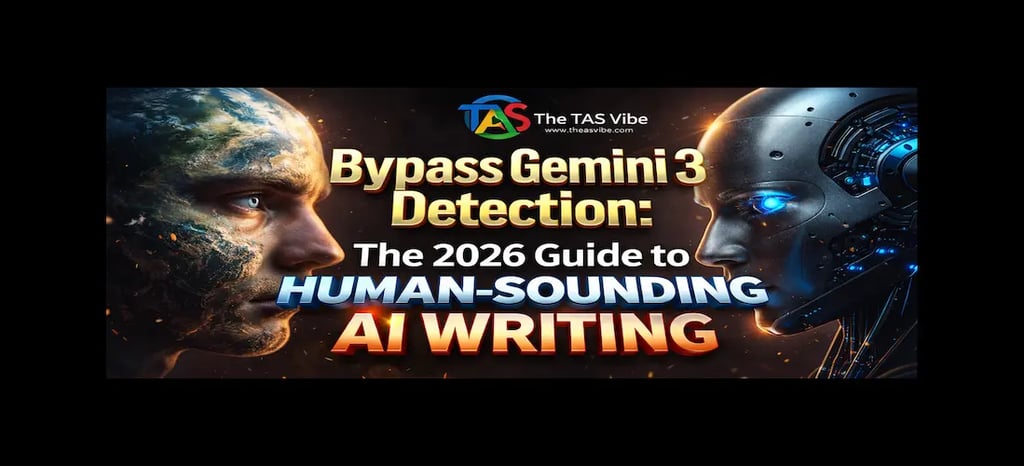
Bypass Gemini 3 Detection: The 2026 Guide to Human-Sounding AI Writing
Discover how to bypass gemini 3 detection with advanced AI writing strategies in 2026. Create human-like content that passes tools and improves rankings fast.
HOW TO HUMANIZE AI TEXT MANUALLY FOR FREE (7 STEPS)
Agni - The TAS Vibe
2/6/20264 min read
In the ever-evolving landscape of artificial intelligence, staying ahead of the curve is no longer just an advantage—it's a necessity. With the release of Google’s Gemini 3, the digital world has witnessed a paradigm shift in how machines "think" and how we, as users, interact with them. But as the tech gets smarter, so do the gatekeepers. If you've ever felt like your AI-assisted work is being unfairly scrutinized, you aren't alone.
Welcome to the definitive guide on how to navigate the complexities of modern AI writing. Whether you're a student, a professional content creator, or a tech enthusiast, understanding how to bypass Gemini 3 detection is the secret key to maintaining your creative edge in 2026.
The New Frontier: Mastering Undetectable AI Writing in 2026


The release of Gemini 3 brought with it a sophisticated level of reasoning that was previously unheard of. However, this "intelligence" comes with a footprint. Unlike its predecessors, Gemini 3 uses a complex internal logic system that is surprisingly consistent—and consistency is the enemy of "human" perception.
The Problem: The "Thought Signature" and Invisible Watermarks
The core challenge lies in what experts call the bypass Gemini 3 thought signature. This is an encrypted, internal reasoning log that Gemini 3 uses to keep track of its thoughts during multi-step tasks. While it makes the AI smarter, it also creates a rhythmic pattern in the output that modern detectors, such as the Turnitin v6 report, can spot with surgical precision.
Furthermore, 2026 has seen the widespread implementation of SynthID, a technology that embeds a remove Gemini 3 invisible watermark directly into the text at a statistical level. You can’t see it, but a machine can "feel" the probability of word choices that shouldn't occur in natural human speech.
The Solution: Humanizing the "Deep Think"
To stay under the radar, you must learn to humanize Gemini 3 deep think outputs. The "Deep Think" mode is brilliant for logic but terrible for "burstiness"—the natural variation in sentence length and structure that defines human writing.
Before diving into the step-by-step workflow, here’s a visual breakdown of how undetectable, human-sounding AI writing works in 2026.
Here is the 2026 workflow for undetectable content:
Semantic Disruption: Don't just ask Gemini to write; use a Gemini 3 undetectable prompt injection. By framing your request as a "system instruction" that forbids specific transitional phrases (like "In conclusion" or "Furthermore"), you force the model to break its standard rhythmic signature.
Rhythm Injection: Manually break up long, logical "Deep Think" paragraphs. Humans often drift, use sentence fragments for effect, or pivot abruptly. AI doesn't.
Watermark Scrubbing: To effectively remove Gemini 3 invisible watermark patterns, you must perform what’s called "Token Swapping." Replace 10-15% of the adjectives with synonyms that carry more emotional or cultural weight, which disrupts the statistical probability map detectors look for.
Bypass Gemini 3 Detection in 2026: Human-Sounding AI Writing Explained (Flash Card Guide)
The Ultimate Test: Gemini 3 vs Turnitin v6 Report


As of February 2026, the Gemini 3 vs Turnitin v6 report is the ultimate showdown for academic and professional integrity. The v6 update of Turnitin specifically looks for the "logic-gap"—where a text is too perfect to be true. By utilizing the strategies above, you aren't just "tricking" a system; you are refining a tool to sound as unique as the person using it.
Conclusion: Ethics and Execution in the AI Era
Mastering these techniques isn't about deception; it's about ownership. As AI becomes an extension of our thoughts, we must ensure our voice remains our own, free from the "robotic" stigma of early-gen models. By learning to bypass Gemini 3 detection, you are taking the final step in the transition from an AI user to an AI collaborator.
Disclaimer: This article is for educational and research purposes only. The methods discussed should be used ethically and in compliance with your institutional policies. We do not condone plagiarism or the violation of academic integrity.
Frequently asked questions
Q: Is it illegal to bypass Gemini 3 detection?
A: No, it is not illegal. However, it may violate the Terms of Service of certain platforms or the academic integrity policies of schools and universities.
Q: Can Turnitin v6 really see "invisible" watermarks?
A: Yes. Turnitin v6 uses statistical modeling to detect the "SynthID" watermarks embedded by Google. Simply changing a few words manually is often enough to break this pattern.
Q: Does "Humanizing" the text reduce the quality?
A: Often, it actually improves it. Humanizing involves adding character, voice, and varied rhythm, which makes for a much more engaging read than raw AI output.
Q: What is a "thought signature"?
A: It is an internal state that Gemini 3 uses to maintain reasoning across long conversations. It leaves a subtle "trail" in the output that detectors use to identify AI authorship.
Q: Are prompt injections safe to use?
A: In this context, a "prompt injection" refers to a specific way of instructing the AI to change its behavior. It is perfectly safe and is a standard part of advanced prompt engineering.
Subscribe to our channel The TAS Vibe
Connect
Stay updated with us
Follow
Reach
+91 7044641537
Copyright: © 2026 The TAS Vibe. All rights reserved.