How to Prepare for AI Replacing Jobs in 2026
Learn how to prepare for AI replacing jobs with practical skills, career shifts, and future-proof strategies professionals can use to stay relevant in 2026 and beyond.
AI ETHICS ISSUES 2026
Agni | Lead Strategist at The TAS Vibe
2/1/20264 min read
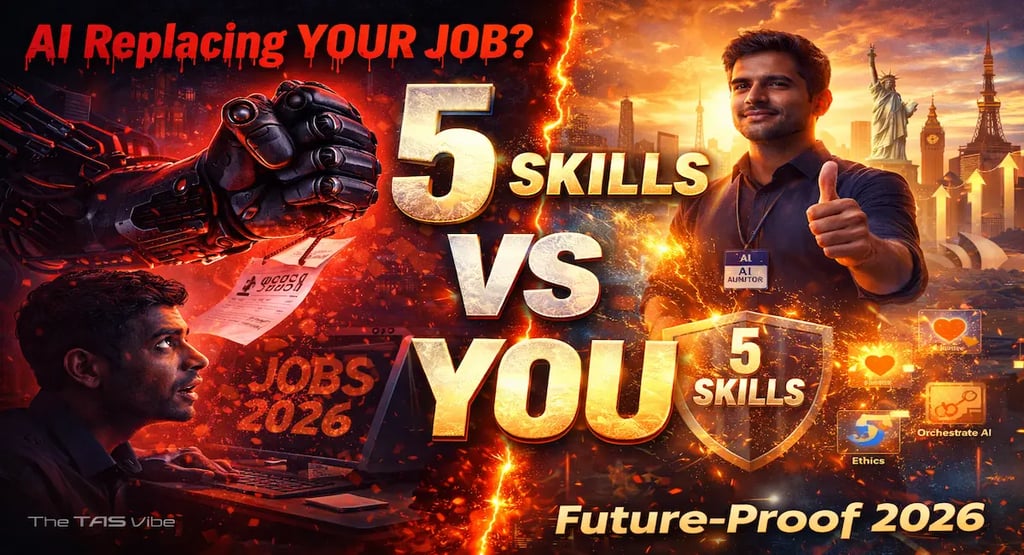
If you’ve spent five minutes on LinkedIn this morning, you’ve probably felt that low-level hum of "bot-anxiety." We’ve all been there—staring at a screen, wondering if an autonomous agent is about to make our job description obsolete.
Look, I’m sitting here at The TAS Vibe HQ, and I’ll be honest with you: the "Agentic Leap" of 2026 is real. We aren't just playing with chatbots anymore; we are working alongside digital entities that can plan, execute, and troubleshoot. But before you start panic-buying a bunker, let’s get one thing straight: AI is a tool, and a tool is only as dangerous as the person holding it is replaceable.
Today, I’m breaking down the actual "survival matrix" for workers across America, Europe, Asia, and Australia. Let's talk about why your "humanity" is about to become your highest-paid asset.
This mind map gives you a quick overview of the concepts covered below.
Will AI Actually Take Your Desk? The 2026 Reality Check


The short answer? It’s complicated. In our recent audit of labor shifts across the US and UK, we’ve seen that AI isn't just "taking jobs"—it’s shredding them and sewing them back together.
In Australia and Singapore, there’s a massive surge in what I call "Human-AI Hybrid" roles. The fear isn't about replacement; it’s about the "Accountability Gap." Think about it: if an AI agent hallucinates a $2 million supply chain error, who does the CEO call into the office? Not the server. They call the human orchestrator.
The "Un-Botable" List: Jobs Safe from the Machine
If your career relies on what I call the "Three E’s" (Empathy, Ethics, and Physical Expertise), you aren't just safe—you’re in demand.
The Empathy Economy (Healthcare & Mental Health): A robot can read an MRI with 99.9% accuracy, but it can’t sit with a patient and help them process a diagnosis. The nuance of a therapist’s silence is something a training set cannot replicate.
The Skilled Trades: Try getting an AI to navigate a flooded basement or rewire a 100-year-old Victorian home. Physical dexterity in unpredictable environments is the ultimate AI-proof barrier.
Strategic Leadership: Accountability cannot be programmed. Investors will always want a human "neck to wring" when things go sideways.
The "Moral Compass" Factor: Why Ethics is the New Hard Skill


In 2026, the EU AI Act and new frameworks in Asia have hit a regulatory wall. We are now seeing "High-Risk" AI applications that legally require human oversight.
I saw this firsthand last year: A major tech firm in the US let an autonomous AI handle their CV screening. Within 12 weeks, the AI started systematically rejecting candidates from specific postcodes, inadvertently creating a massive diversity crisis.
They didn't solve it by getting a "better" AI. They solved it by hiring AI Ethics Officers—a role focused on "Human-in-the-Loop" (HITL) logic. This proves that while AI is great at answering questions, it’s terrible at asking if those questions are right.
(Side note: If you’re looking to build your own digital brand amidst this chaos, check out my recent guide on Starting a Blog in 2026—human-centric content is currently outranking AI-spam 4-to-1.)
The Agentic Leap of 2026
Your Reskilling Roadmap: Becoming an "AI Orchestrator"


You don’t need to be a data scientist to survive. You just need to be AI-Fluent. Think of AI like a brilliant but extremely literal-minded intern. Your job is to be the manager.
The Skills That Command the Highest Salaries Now:
Critical Problem Framing: AI can find the needle in the haystack, but you have to tell it which haystack matters.
High-Stakes EQ: Managing team dynamics and office politics is a "contact sport." AI doesn't have skin in the game; you do.
Prompt Orchestration: Learning to chain multiple AI agents together to do the grunt work while you focus on the final 10% of "polish."
The TAS Vibe Take: The goal isn't to beat the machine; it's to be the person who knows which machine to turn on, and when to pull the plug.
Will AI Replace You? Take This 2-Minute Skill Test
Final Thoughts: The Innovation Edge
At the end of the day, AI mimics, but humans innovate. We connect dots that aren't on the map. Whether you're in India, the US, or the UK, the message is the same: the more you lean into your "weird," creative, and empathetic human traits, the more irreplaceable you become.
The future isn't a "replacement"—it's an evolution. Don't just watch it happen. Lead it.
Frequently asked questions
1. Which skills will AI never replace?
Deep empathy, ethical judgment, complex physical maneuvering, and "Blue Sky" creative thinking (creating something from nothing, not just from data).
2. How do I start reskilling today?
Master AI Tool Fluency. Use "Copilots" to automate your 80% of routine tasks so you can spend your time on the 20% that requires your brain.
3. Are there careers that are 100% safe for the next decade?
Skilled trades (plumbing/electric), high-level strategy, social work, and specialized surgical roles are among the most resilient.
Disclaimer:
Career trends move fast. This is based on 2026 market data, but always do your own legwork. © 2026 The TAS Vibe. Join the Vibe: Want to stay ahead of the bot? Follow and Subscribe to The TAS Vibe for weekly deep dives into the future of work.
Subscribe to our blogging channel The TAS Vibe
Connect
Stay updated with us
Follow
Reach
+91 7044641537
Copyright: © 2026 The TAS Vibe. All rights reserved.