
Nemotron 3 Super API pricing vs GPT-5: Full Comparison
Compare Nemotron 3 Super API pricing vs GPT-5 to optimize your AI budget. Discover which model offers better cost-per-token and performance for your business.
BEST AI TOOLS FOR BUSINESS AUTOMATION ROADMAP 2026
Agni - The TAS Vibe
3/13/20263 min read
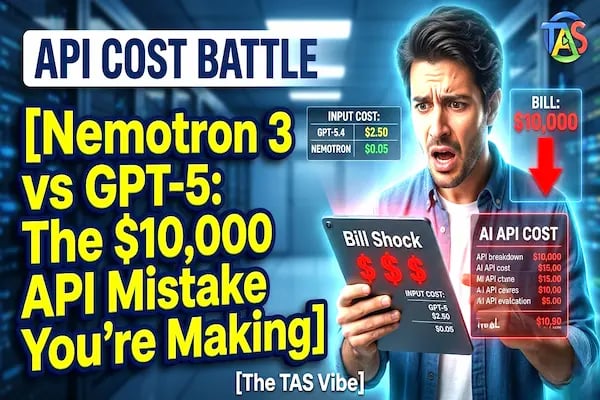

If you’re building autonomous agents in 2026, your AWS or OpenAI bill is probably looking like a mortgage payment. The March release of NVIDIA’s Nemotron 3 Super has officially ended the "closed-source" tax, throwing a massive wrench into OpenAI’s GPT-5.4 dominance.
The bottom line? Nemotron 3 Super API pricing vs GPT-5.4 isn't just a minor difference—it’s a 50x cost chasm. While GPT-5.4 offers "zero-shot" brilliance, developers are flocking to Nemotron’s Mamba-Transformer hybrid because it is 5x faster for long-form code and significantly cheaper for the "reasoning loops" that define agentic workflows.
Decoding the Cost: GPT-5.4 Thinking vs Nemotron 3 Reasoning Cost
In 2026, we aren't just paying for words anymore; we’re paying for "thoughts." OpenAI’s GPT-5.4 introduces a "Thinking Tax." Every time the model pauses to reason through a complex math problem or a multi-step coding task, those internal tokens are billed at the full output rate of $15.00 per 1M tokens.
Nemotron 3 Super flips the script. Using a 12B active parameter Mixture-of-Experts (MoE) architecture, it achieves high-level logic while burning 40% fewer tokens. Because NVIDIA controls the hardware stack (B200/X100 GPUs), they’ve optimized the GPT-5.4 Thinking vs Nemotron 3 Reasoning cost to favor high-frequency, multi-step loops where token volume is 10x higher.
Token Throughput Performance: Nemotron 3 Super vs GPT-5.4
Speed isn't just a luxury; in agentic workflows, latency is money. If an agent takes 30 seconds to "think" before tool-calling, your compute costs balloon.
The Nemotron 3 Super vs GPT-5.4 token throughput gap comes down to the Mamba Advantage. Unlike GPT-5.4’s pure Transformer architecture (which slows down as context grows), Nemotron uses Mamba layers for linear scaling.
Nemotron 3 Super: 140+ tokens/sec (on NVIDIA B200).
GPT-5.4: ~80 tokens/sec (Average).
This higher throughput reduces the "Time to First Token" (TTFT), ensuring your agents don't hang while waiting for a response. If you're looking to integrate these high-speed flows into a larger strategy, check out our Best AI Tools for Business Automation Roadmap 2026.
Dealing with the 1-Million Token Context Window
Ever tried to feed an entire 1,500-page codebase into GPT-5.4? Your credit card might catch fire. Nemotron 3 Super 1M context window pricing is a flat $0.05 per 1M input tokens. > Featured Snippet: Is Nemotron 3 Super better for RAG?
Nemotron 3 Super offers a 1-million-token context window designed for RAG and long-form coding. Unlike GPT-5.4, which scales costs linearly and adds premiums for long-context windows, Nemotron 3 Super costs approximately $0.05 per 1M tokens. This makes processing entire repos or massive PDFs roughly 50x cheaper than using closed-source models.
In RULER benchmarks, Nemotron maintains 99% recall across that 1M window. GPT-5.4 is brilliant, but it starts "forgetting" the middle of the document once you cross the 256k threshold.
Dedicated Infrastructure vs. Managed API: The Billing Battle
The real decision for CTOs in 2026 isn't just the model—it’s the billing model.
OpenAI Auto Top-Up
OpenAI relies on a "Prepaid/Postpaid" usage model. It’s convenient for small teams, but the "Auto Top-Up" feature can lead to massive "bill shocks" if an autonomous agent gets stuck in an infinite loop.
Together AI / NVIDIA NIM (Dedicated Inference)
With NVIDIA NIM pricing for Nemotron 3 Super, you often move away from per-token billing. Instead, you use Dedicated Inference: renting a GPU cluster (like a 1x H200 node) at a fixed hourly rate.
The Break-Even Point: If your agents are pushing more than 50M tokens per month, self-hosting a NIM on Together AI or Azure is significantly cheaper than paying OpenAI’s per-token fees.
Strategic E-E-A-T: Common Myths & Real-World Realities
Myth: "Open-weights models aren't smart enough for complex coding."
Reality: Nemotron 3 Super utilizes Multi-Token Prediction (MTP) layers. In recent SWE-Bench tests, it matched GPT-5.4 in solving GitHub issues because it "sees" several tokens ahead, preventing the logical dead-ends that plague smaller models.
Case Study: A lead dev on Reddit recently reported that their voice-AI agent saved 85% in API costs by switching to Nemotron 3 for tool-calling. They kept GPT-5.4 only for the final "Human-Synthesis" layer.
The Warning: Nemotron can still fail the "Chess Gauntlet." For deterministic, purely algorithmic tasks, it can occasionally enter a "hallucination loop," burning tokens without progress. For those high-stakes logic puzzles, you might still need the strategies we covered in How to pass Humanity's Last Exam AI.
Pro-Tips for Optimizing Your 2026 AI Budget
The "Thinking Budget" Hack: Nemotron allows you to toggle the reasoning depth. For simple data extraction, dial the "thinking" down to save an extra 30% on compute.
Context Caching: Use providers that support NVFP4 quantization. This can drop your input costs from $0.05 to $0.005 for repeated system prompts.
Conclusion: Which Should You Choose?
Choose GPT-5.4 If: You need the absolute highest "Intelligence Index" (57.0+) for creative writing, abstract research, or if your workflow requires native video-to-video input.
Choose Nemotron 3 Super If: You are building autonomous agents, high-volume RAG systems, or coding assistants. When you need 5x faster throughput and a pricing model that doesn't punish you for "thinking," NVIDIA wins.
For most agentic workflows in 2026, the NVIDIA ecosystem (Nemotron + NIM) provides the most scalable cost-to-performance ratio on the market.
Get in touch
Subscribe to our blogging Channel "The TAS Vibe"
Connect
Stay updated with us
Follow
Reach
+91 7044641537
Copyright: © 2026 The TAS Vibe. All rights reserved.