10 Best New AI Coding Assistant 2026 Tools for Devs
Explore the best new ai coding assistant 2026 tools. Master agentic workflows, multi-file edits, and auto-debugging to ship your code faster than ever before!
AI CODING TOOLS
Agni - The TAS Vibe
3/21/20266 min read
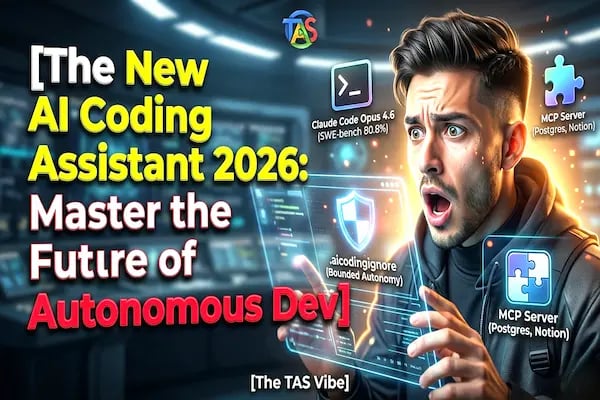
Remember when "AI coding" meant fighting with GitHub Copilot over a broken for loop? That era is officially dead. As of March 2026, we’ve moved from autocomplete to Autonomous Agents—AI that doesn't just suggest code but actually ships it while you’re out grabbing a coffee.
Whether you're a "Vibe Coder" building your first SaaS or a Senior Architect managing a complex legacy migration, the new AI coding assistant 2026 landscape is moving at a breakneck pace. If you aren't using agentic workflows yet, you're essentially writing code with a quill and parchment.
This guide breaks down the latest shifts—from the record-breaking Claude 4.6 to "Overnight Agents"—and how to integrate them into your stack today.
The New AI Coding Assistant 2026: Why the Developer Workflow Just Changed Forever
The developer's role has fundamentally shifted from writing code to orchestrating it. In 2024, we were impressed by simple snippets. Today, the new AI coding assistant 2026 acts as a full-stack engineer.
The catalyst? Anthropic’s Claude 4.6 Opus. It just shattered the industry-standard SWE-bench with a staggering 80.8% resolution rate. For context, that means it can identify, reproduce, and fix complex, multi-file GitHub issues better than most junior developers.
This isn't just for the pros. For the 15-35 demographic, this has sparked the "Vibe Coding" revolution. If you can describe it, the AI can build it. The barrier to entry has vanished, but the ceiling for what a single person can build has reached the stratosphere. From "Overnight Agents" that clear your backlog while you sleep to Google Stitch AI turning Figma designs into functional React apps in seconds, the game has changed.
Claude Code vs Cursor Agent Mode: The Battle for the 2026 IDE Throne
If you've been following our Cursor AI vs GitHub Copilot 2026: The Ultimate AI Coding Guide, you know that Cursor has long been the gold standard. But a new challenger has entered the ring.
The Architecture Debate: Terminal vs. GUI
Claude Code (Terminal-First): Anthropic's new CLI-native tool is built for speed. It lives in your terminal, has full access to your filesystem, and executes commands directly. It’s lean, mean, and incredibly precise for refactors.
Cursor Agent Mode (GUI-First): Cursor remains the "luxury" experience. Its "Agent Mode" provides a visual, multi-turn chat interface that feels more like collaborating with a pair programmer who can see your entire screen.
Why Opus 4.6 is Dominating
Currently, Opus 4.6 is outperforming OpenAI’s "o3-mini" in codebase reasoning. While OpenAI focuses on raw logic, Claude understands context. It’s better at realizing that changing a variable in auth.ts will break a specific middleware in your server/ folder—something older models constantly missed.
The MCP Advantage
Claude Code's secret weapon is the Model Context Protocol (MCP). It allows the assistant to read your Slack channels for project requirements or scan Jira tickets to understand the "why" behind a bug. It’s not just looking at your code; it’s looking at your entire business context.
Verdict: Which one should you use? | Project Scale | Recommended Tool | Why? | | :--- | :--- | :--- | | Quick UI Tweaks | Cursor Agent Mode | Visual feedback is king for frontend. | | Deep Logic/Refactoring | Claude Code | Terminal access allows for faster file manipulation. | | Non-Technical "Vibes" | Lovable / Replit | Zero-config, browser-based deployment. |
[Featured Snippet] What is a New AI Coding Assistant in 2026?
In 2026, a new AI coding assistant is an "Agentic System" capable of autonomous, multi-step reasoning across an entire repository. Unlike earlier LLMs that provided fragmented code snippets, 2026 assistants utilize the Model Context Protocol (MCP) and high-reasoning models (like Claude 4.6 or GPT-5) to identify bugs, write tests, refactor across multiple files, and deploy code without human intervention. This evolution has birthed the "Vibe Coding" movement, where natural language intent is the primary syntax for software creation.
How to Set Up an Overnight Coding Agent (Step-by-Step)
Social media is currently flooded with "I cleared 40 GitHub issues while I slept" threads. This isn't hype; it's the overnight coding agent setup in action.
The Trend: 6-Hour Backlog Clearance
Developers are using "Headless Agents" to perform boring maintenance—like upgrading dependencies or writing unit tests—during their off-hours.
Safety & Guardrails: Bounded Autonomy
You don't want to wake up to a $5,000 API bill or a deleted database.
Budget Caps: Set a hard token limit (e.g., $20 per run).
File Scoping: Use a .aicodingignore file to prevent the agent from touching sensitive config files.
Dry Runs: Set the agent to "Propose" changes rather than "Commit" them.
The Tooling Stack
To get started, use Aider or Claude Code in conjunction with a CI/CD pipeline.
Initialize the agent in your repo.
Provide a specific list of tasks (e.g., "Refactor all Class components to Functional components").
Let the agent run in a sandboxed environment.
The "Human-in-the-Loop" Review: Always start your morning by reviewing the Git Diff summaries. Use the AI to summarize its own changes so you can approve them in bulk.
Google Stitch AI for Figma: Bridging the Gap Between Design and Deployment
The "design-to-code" handoff used to be a nightmare of redlines and CSS discrepancies. Google Stitch AI for Figma has effectively killed that friction.
The "One-Click" Reality
Google recently dropped an update to Stitch that allows you to select a 5-screen flow in Figma and click "Export to Code." It doesn't just spit out messy HTML; it generates clean, modular React/Tailwind components.
Logic Mapping
Stitch AI's brilliance lies in Logic Inference. It looks at a button labeled "Login" and automatically generates the onSubmit handlers and state management (React Hooks) needed to make it functional. It even maps your Figma variables to your Tailwind config.
The Rise of the MCP Server for Coding Assistants
Think of the Model Context Protocol (MCP) as the "USB-C for AI tools." Before MCP, every AI tool had to build its own custom integration for Slack, GitHub, or Postgres.
Now, you can run a local MCP server for coding assistants that acts as a secure bridge. This allows your AI to "see" your local database schema or browse your private Notion docs to find API specifications. The community marketplace is already full of pre-built servers, making it easier than ever to give your AI "eyes" on your private data.
Vibe Coding with Lovable and Replit: The New Founder’s Meta
For the 15-25 age bracket, "coding" is no longer about learning syntax; it's about Vibe Coding with Lovable and Replit. Non-technical founders are reaching $10k Monthly Recurring Revenue (MRR) by simply "vibing" with the AI—describing features in plain English and letting Lovable handle the frontend while Replit Agent manages the backend and hosting.
In 2026, syntax-heavy languages like C++ or Rust are becoming specialized "low-level" skills. For everyone else, Product Architecture and System Thinking are the only languages that matter.
Expert Insights & Common Myths: The E-E-A-T Section
Myth: AI is replacing developers. Reality: AI is replacing tasks, not people. It’s killing boilerplate, unit testing, and basic debugging. This shifts your role to System Architect. You spend less time typing and more time deciding what to build.
Case Study: The 30-Day FinTech Build In early 2026, a two-person startup utilized agentic workflows to build a fully compliant FinTech app in just 30 days. One person focused on "Product Vibes" (UX/UI via Stitch AI), while the other managed the "Agentic Backlog" (Security/Compliance via Claude Code).
The "Hallucination" Warning As AI gets faster, your tests must get better. In 2026, automated unit testing is your only defense against high-speed hallucinations. Never ship AI code that hasn't passed a local test suite.
Future-Proofing Your Career: AI Tools & Productivity
To stay relevant in the 2026 market, you need to master these four pillars:
Ultimate Guide to AI Tools: Stay updated on IDEs and local LLM hosting at our AI Coding Tools section.
Make Money Using AI: Focus on "One-Person SaaS" models powered by agents.
AI for Students: Build a portfolio of shipped products, not just certificates.
The Future of AI: Prepare for "AGI-Lite" where agents handle 90% of the maintenance lifecycle.
💡 Pro-Tip 1: Always use a Local MCP Server for sensitive data. Never feed your production credentials directly into a cloud-hosted AI assistant.
💡 Pro-Tip 2: The "Golden Prompt" for 2026: Instead of asking the AI to "Write a function," ask it to "Research the repository architecture and propose a refactor that follows our existing patterns."
Conclusion
The new AI coding assistant 2026 isn't just a tool; it's a digital coworker. Whether you're optimizing your workflow with Claude Code or building a startup via Vibe Coding, the window of opportunity to be an early adopter is closing.
Ready to automate your workflow? [Download our Overnight Agent Setup Checklist here] and join our community of 50,000+ AI Architects building the future.
Get in touch
Connect
Stay updated with us
Follow
Reach
+91 7044641537
Copyright: © 2026 The TAS Vibe. All rights reserved.