OpenAI Adult Mode Delay Reason: March 2026 Update
Discover the OpenAI Adult Mode delay reason in the March 2026 update. Learn why OpenAI postponed the feature again and what it means for users and safety today.
OPENAI 100B ROUND STOCK SYMBOL: IS IT PUBLIC?
Agni - The TAS Vibe
3/9/20265 min read
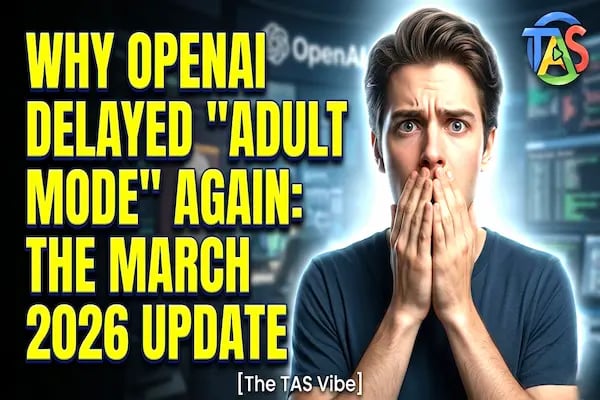
If you’ve been refreshing your ChatGPT settings waiting for that promised "Adult Mode" toggle, you aren't alone. The hype was real, but the wait just became indefinite. While rumors of server crashes circulated, the actual OpenAI Adult Mode delay reason is far more complex than a simple technical glitch. We are witnessing a fundamental pivot in how OpenAI operates, moving away from user-driven freedom toward a strictly regulated "Proactive Intelligence" framework.
This isn't just another missed deadline; it’s a total shift in the company’s DNA. From leaked internal memos to high-stakes legal battles in North America, here is the real story behind why your AI just got a lot more restrictive.
The "Code Red" Pivot: Analyzing the OpenAI "Code Red" Memo Leaks
The internet went into a frenzy last week when the OpenAI "Code Red" memo leaks hit Reddit and X. These internal documents reveal that the "Adult Content Toggle" team—the group responsible for building the framework for uncensored RP and mature themes—was effectively gutted overnight.
According to the leaks, OpenAI leadership issued a "Code Red" order to reallocate nearly 60% of their creative safety engineers to the "Global Compliance" wing. The goal? To prioritize a new internal filtering layer known as Project Guardian.
Resource Reallocation: Engineers originally tasked with refining the "Adult Mode" nuances are now building real-time monitoring tools.
The Pivot: This move signals that OpenAI is no longer interested in being the "everything store" for content; they are terrified of the legal liability that comes with unrestricted generations.
The "Guardian" Shadow: Project Guardian is designed to replace the toggle entirely with an AI that "nudges" users away from mature themes before a prompt is even finished.
If you're already seeing errors during complex prompts, you might be running into these new filters. Check out our guide on the GPT-5.4 Thinking Plan Error to see how to navigate these early-stage technical hurdles.
Privacy vs. Access: The Truth About ChatGPT Age Verification Facial Scan Privacy
To get "Adult Mode," OpenAI is going to need to see your face—literally. One of the biggest hurdles causing the current delay is the integration of a mandatory 3D biometric mapping system.
The ChatGPT age verification facial scan privacy debate is heating up among the 15-30 demographic. Many users are rightfully sketched out by the idea of handing over biometric data to a company that already has a massive log of their most private conversations.
The Biometric Barrier: Unlike a simple "I am over 18" click, this system uses your camera to estimate age and verify ID in real-time.
Third-Party Handshakes: OpenAI isn't doing this alone. They are partnering with identity firms that may keep your biometric "hash" on file for years.
Data Persistence: There is currently no clear answer on how long these scans are stored or if they are tied directly to your GPT-5.4 training profile.
[Featured Snippet] What is the primary OpenAI Adult Mode delay reason in 2026?
The primary OpenAI Adult Mode delay reason stems from a combination of the "Code Red" internal policy shift and a mandatory OpenAI vs Canada safety protocol update. Following intense legal pressure to implement "Proactive Intelligence," OpenAI has paused the rollout of unrestricted modes to integrate a mandatory biometric age verification system. This delay ensures that the "Adult Mode" (now internally called the "Sensitive Creative Suite") complies with international safety standards and liability insurance requirements before a broader Q2 release.
The Legal Wall: The OpenAI vs Canada Safety Protocol Update
Why is a country with 40 million people holding up a global release? Because the OpenAI vs Canada safety protocol update is being used as the "Gold Standard" for global compliance.
The Canadian Radio-television and Telecommunications Commission (CRTC) recently hit OpenAI with a series of "Safety Pledges." To avoid a massive ban, Sam Altman agreed to turn Canada into a testing ground for Proactive Intelligence.
Precedent Setting: If OpenAI can satisfy Canadian regulators with their biometric gates and "Guardian" filters, they can use that same blueprint to satisfy the EU and the US.
What is Proactive Intelligence? It’s a shift from "Passive Filtering" (blocking a response after it's generated) to "Active Refusal" (the AI refusing to even think about a prompt that violates real-time safety logs).
The Bottleneck: Integrating these country-specific legal requirements into the global model has turned the "Adult Mode" launch into a logistical nightmare.
Executive Insights: The Fidji Simo OpenAI Interview Q1 Delay
The most telling evidence came from a recent Fidji Simo OpenAI interview Q1 delay discussion. The CEO of Applications was remarkably candid about the "refined" roadmap for 2026.
Simo hinted that the company is moving away from the idea of a "wild west" uncensored mode. Instead, they are focusing on "Active Personality Alignment." In plain English? They want to give you an AI that feels "edgy" without actually breaking any corporate safety rules.
The "Refined" Roadmap: Simo’s comments suggest that a "True" Adult Mode—one without filters—is officially dead.
The New Reality: Expect a "Sensitive Suite" that allows for some violence or romance, but remains strictly gated behind facial scans and "Guardian" oversight.
The company is clearly prioritizing its corporate image, especially as it eyes a potential move toward the public market. For those tracking the financial side, our deep dive into the OpenAI 100b round stock symbol explains why these safety delays are actually a play for Wall Street's approval.
No More Waiting? Best GPT-4o Alternatives for Uncensored RP
If you’re tired of the corporate gatekeeping, you’re not alone. A massive migration is happening. Power users are ditching the cloud for local models that don't care about "Code Red" memos or Canadian safety pledges.
If you want freedom, these are the best GPT-4o alternatives for uncensored RP right now:
Dolphin-Llama 3: The current king of local LLMs. It’s trained specifically to be "compliant" to the user, not a board of directors.
Grok 3.0: xAI is leaning hard into the "anti-woke" and "anti-censorship" angle. If you have the hardware, Grok is the closest cloud-based rival to an unrestricted GPT.
Mistral Large (Unfiltered): The European dark horse. It offers high-level reasoning without the preachy "As an AI language model..." lectures.
Pro-Tip: If you value privacy and zero-latency uncensored output, local LLMs (Large Language Models) are now outperforming cloud-based "Adult Modes" plagued by safety guardrails. You just need a decent GPU.
Common Myths vs. Reality: The "Adult Mode" Edition
Myth: OpenAI is just being "puritanical" or "woke." Reality: It’s a liability insurance issue. High-risk content dramatically increases the cost of insurance for tech giants and creates "brand safety" risks that scare off the $100B investors.
Myth: The delay is due to server load or GPU shortages. Reality: The OpenAI Adult Mode delay reason is 90% legal/compliance and 10% technical. The hardware is ready; the lawyers are not.
Myth: A VPN will let you bypass the "Adult Mode" block. Reality: Not anymore. With the shift toward facial scan privacy requirements, your IP address is irrelevant. If the AI doesn't verify your biometrics, the toggle stays locked.
Conclusion: Will We Ever See an "Unfiltered" ChatGPT?
The technology for an unfiltered ChatGPT exists today. The reason you don't have it isn't because OpenAI can't build it—it’s because they can't afford the risk of owning it.
As we move through 2026, the dream of a simple "On/Off" switch for adult content is fading. It is being replaced by "Personalized Alignment," a system that knows who you are, verifies your face, and monitors your intent in real-time. For many in the 15-30 demographic, this "freedom" feels a lot like surveillance.
Strategist’s Insight: Watch for the term "Adult Mode" to disappear from official docs. It's being rebranded as the "Sensitive Creative Suite" to make it more palatable for advertisers and the upcoming IPO.
Tired of waiting for the toggle? Download our 2026 Guide to Local LLMs and learn how to run a private, uncensored GPT-4 alternative on your own hardware today!
Get in touch
Subscribe to our Blogging Channel "The TAS Vibe"
Connect
Stay updated with us
Follow
Reach
+91 7044641537
Copyright: © 2026 The TAS Vibe. All rights reserved.