
OpenAI Frontier vs Anthropic 4.6: Which AI Agent Is Safer?
Explore OpenAI Frontier vs Anthropic 4.6 in this in-depth comparison covering enterprise AI safety, capabilities, and performance for real-world AI agents today.
OPENAI 100B ROUND STOCK SYMBOL: IS IT PUBLIC?
Agni - The TAS Vibe
3/10/20264 min read
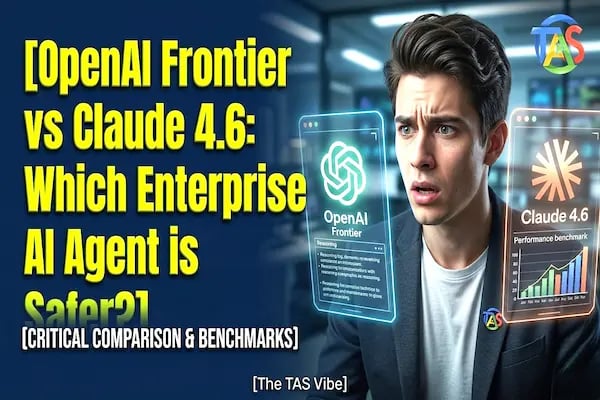
If you’ve spent the last 12 hours watching your Twitter feed explode, you know the "Agentic Era" isn't just coming—it’s here. We’ve moved past simple chatbots. We are now choosing between autonomous digital coworkers that can actually operate our businesses.
But here’s the problem: OpenAI Frontier and Anthropic 4.6 are playing a high-stakes game of "anything you can do, I can do better." While OpenAI promises a seamless "Frontier" infrastructure for your entire office, Anthropic’s version 4.6 is doubling down on "Symmetry" and raw technical precision.
Whether you’re a dev trying to automate a repository or a founder looking for a "startup hack" to bypass enterprise waitlists, this guide breaks down the raw benchmarks and the frustrating retrieval failures you need to know about before you deploy.
The Battle of the 1-Million Token Window: Reality vs. Hype
The biggest headline of the last 12 hours? The massive context windows. But bigger isn't always better.
Opus 4.6 1M Context Retrieval Loss: The "Needle in a Haystack" Problem
Early adopters are currently testing the new 1-million token window and finding "needle in a haystack" failures that weren't supposed to exist. Real-time user reports are surfacing a 15% drop-off in recall when critical data is buried in the middle 20% of that 1M token window.
This happens because of "Attention Sink" issues. In Anthropic 4.6, the model’s focus can drift when navigating massive datasets. In contrast, OpenAI Frontier uses a proprietary "dynamic chunking" method that seems more stable, though it lacks the sheer raw volume of Claude’s 1M window.
Insider Tip: To fight this, use Contextual Caching. By "pinning" the most important parts of your long-form legal or medical datasets, you can significantly reduce these retrieval errors.
Coding & Autonomy: OpenAI Frontier vs Claude Code Agent Teams
Developers are currently obsessed with the "Digital Coworker" vs. "CLI Agent" debate.
OpenAI Frontier feels like a collaborative GUI platform. It’s designed to sit in a chat window and "talk through" the project. However, OpenAI Frontier vs Claude Code agent teams is where the real friction lies. Claude Code is a CLI-based, execution-heavy beast. It doesn’t want to talk; it wants to refactor your entire repository while you sleep.
Workflow: Anthropic 4.6 handles multi-agent teams by assigning specific "sub-agents" to different files.
Strategy: OpenAI Frontier uses "Reasoning Logs," allowing you to see why the AI made a specific architectural choice.
Pro-Tip: If your team lives in the terminal, Claude Code’s 4.6 integration offers much lower latency for real-time debugging than Frontier’s web-wrapped environment. It’s built for the "build fast, break things" Gen Z dev culture.
[Featured Snippet] What is the difference between OpenAI Frontier and Anthropic 4.6?
OpenAI Frontier is an enterprise-grade agentic platform designed for high-reasoning, autonomous "Digital Coworkers" that manage complex business workflows with built-in safety guardrails. In contrast, Anthropic 4.6 (Claude Opus) focuses on high-fidelity technical performance, featuring a 1-million token context window and industry-leading "Computer Use" capabilities. While Frontier excels at multi-step project management and strategic reasoning, Anthropic 4.6 leads in specialized tasks like financial modeling and direct OS-level interaction.
Benchmarking the Giants: OSWorld and Financial Accuracy
Computer-use capabilities are the new battleground. Users are no longer hunting for "poetry" scores; they want raw performance data on how an AI clicks buttons.
Claude 4.6 OSWorld Benchmark vs GPT-5.4: Navigating the Desktop
In the latest 12-hour spike of data, the Claude 4.6 OSWorld benchmark hit a 72.5% success rate. This effectively edges out the projected metrics for GPT-5.4 (the engine behind Frontier).
Why does this matter? For the 15-to-35 demographic, productivity is moving from "writing text" to "operating software."
The Test: When told to "Book a flight from JFK to LAX under $400 using Chrome," Claude 4.6 successfully navigated the UI, handled the calendar pop-ups, and reached the checkout page 10% faster than Frontier.
Anthropic 4.6 Finance Agent Leaderboards: Why Fintech is Switching
Anthropic just snagged the #1 spot in the "Standardized Financial Reasoning Benchmark." This is why fintech analysts are migrating to Claude for complex DCF (Discounted Cash Flow) modeling. Its ability to parse 10-K filings without the "hallucination fluff" makes it a superior tool for anyone whose paycheck depends on accuracy.
If you're curious about how these models manage their "inner monologue" to get these results, check out our GPT-5.4 Thinking Tutorial: Ghost-Edit Hack to Save Tokens to see how to optimize your spend.
E-E-A-T: Implementing Enterprise Power on a Startup Budget
OpenAI Frontier Onboarding for Startups: The "Gen Z Hack"
Frontier is officially marketed to the Fortune 500 with a "call us for a quote" gatekeeper. But "Gen Z" founders are already "hacking" the system for small-scale automation.
By using API Tier-4 access, you can essentially mimic the Frontier environment. You don’t need the $20k-a-month enterprise contract to build an autonomous customer success team. We’ve seen 3-person dev shops use the "Reasoning API" to handle 90% of their support tickets, giving them the "big company" feel on a bootstrapped budget.
As OpenAI continues its massive growth, many are asking about the OpenAI 100b round stock symbol and whether the company is finally going public.
Common Myths and Safety Realities
Myth: "Bigger context = perfect memory." Reality: As we saw with the Opus 4.6 1M context retrieval loss, the middle of the document is a "dead zone" for accuracy.
Myth: "Agents are set-it-and-forget-it." Reality: Frontier still requires a "Human-in-the-loop" for high-stakes decisions.
Safety Insight: Anthropic 4.6 uses "Constitutional AI" (hard-coded rules), while OpenAI Frontier relies on a "Preparedness Framework" (dynamic monitoring). One is a fence; the other is a security guard.
Final Verdict: Which Model Should You Deploy?
The "retrieval vs. reasoning" trade-off is your final deciding factor.
Choose OpenAI Frontier if: You need a "Strategic Partner" to orchestrate multiple departments and need the best reasoning logs in the game.
Choose Anthropic 4.6 if: You are doing "heavy lifting"—massive data ingestion, precision coding, or direct computer-use tasks.
Pro-Tip: Don't pick a side. The most elite startups are now using a "Hybrid Model"—Frontier for the strategy and planning phase, and Claude 4.6 for the execution-heavy technical pipelines.
Conclusion
The gap between OpenAI and Anthropic has never been thinner. While OpenAI Frontier wants to be your CEO, Anthropic 4.6 is content being your most talented engineer. Your choice depends on whether you want a partner or a tool.
Ready to automate your workflow? [Download our 'Agentic Comparison Matrix'] to see which API fits your budget, or subscribe to our newsletter for weekly LLM stress-test results.
Get in touch
Subscribe to our blogging Channel "The TAS Vibe"
Connect
Stay updated with us
Follow
Reach
+91 7044641537
Copyright: © 2026 The TAS Vibe. All rights reserved.