Real World AI Marketing Automation Case Studies for Small Businesses
Discover real world AI marketing automation case studies for small businesses, showing how solopreneurs boost leads, sales and growth with practical systems
TECHNOLOGYAI MARKETING AUTOMATION FOR SOLOPRENEURS
The TAS Vibe
1/14/202641 min read
My post content
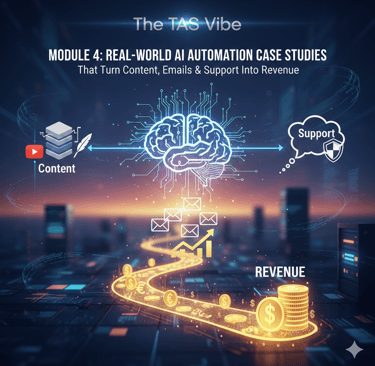
Module 4: Real-World AI Automation Case Studies That Turn Content, Emails & Support into Revenue

📊 Module 4 — Case Studies & Real-World Results
How AI Marketing Automation Transforms Business Operations
Compelling Introduction: Why These Case Studies Truly Matter
In the world of digital marketing, theory is cheap — results are everything.
You’ve probably read dozens of articles explaining what AI marketing automation is, why it’s powerful, and how it could “change your business.” But here’s the uncomfortable truth most marketers won’t admit: automation only becomes valuable when it works in the real world, under real pressure, with real constraints.
This is where most entrepreneurs live — not in theory, but in execution.
For solopreneurs, bloggers, coaches, SaaS founders, and small business owners, the gap between knowing and doing is massive. Time is limited. Budgets are tight. Teams are small or nonexistent. Every tool must justify its cost. Every workflow must save hours, not create new complexity.
That’s why case studies matter more than concepts.
This module doesn’t rely on hype, buzzwords, or imaginary success stories. Instead, it walks you through documented, real-world transformations achieved by businesses that implemented AI marketing automation strategically — not blindly.
These are not Fortune 500 companies with unlimited resources.
These are lean operations that faced problems you likely recognize:
Content overload with inconsistent publishing
Email lists growing but engagement dropping
Customer support eating up entire workdays
Marketing decisions driven by guesswork instead of data
And yet, through intelligent automation, they unlocked something rare in modern business:
👉 More output with less effort
👉 Higher revenue without burnout
👉 Systems that scale without hiring
Whether you’re running a one-person content brand or managing a small marketing team, the following case studies show exactly what happens when AI automation is implemented with intention, not impulse.
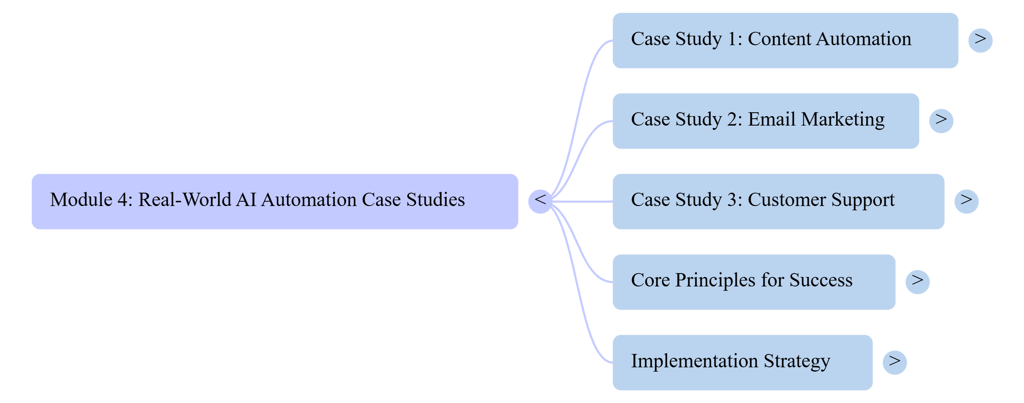
Mind Map
Audio Overview
🔹 Case Study 1: Content Automation — From 30 Hours to 5 Hours Weekly

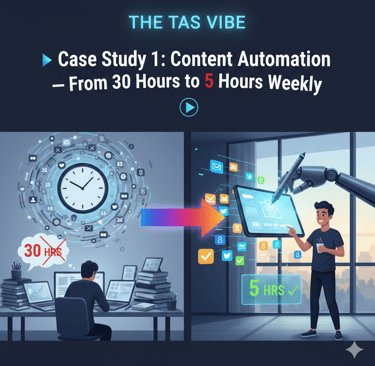
How One Creator Broke the Time Trap Without Sacrificing Quality
Content is the engine of digital growth—but for most creators, it’s also the biggest time thief.
This real-world case study explores how a successful content creator transformed a 30-hour weekly content workload into just 5 hours, using AI-powered content automation—without losing creativity, authenticity, or SEO performance.
If you’re a blogger, solopreneur, or digital marketer feeling buried under endless content tasks, this story will feel uncomfortably familiar—and incredibly hopeful.
The Challenge: The Content Creator’s Time Bottleneck
Every content creator eventually hits the same wall.
As traffic grows and platforms multiply, content creation stops being “just writing.” It becomes a multi-stage production machine that demands time, attention, and mental energy at every step.
In this case, the creator was running a profitable blog while attempting to expand into:
Email marketing
Social media distribution
Affiliate content
Digital products
Despite having strong writing skills and industry knowledge, content production alone was consuming nearly 30 hours every single week.
Not because the work was hard—but because it was manual, repetitive, and fragmented.
Where the Time Was Really Going (And Why It Hurt Growth)
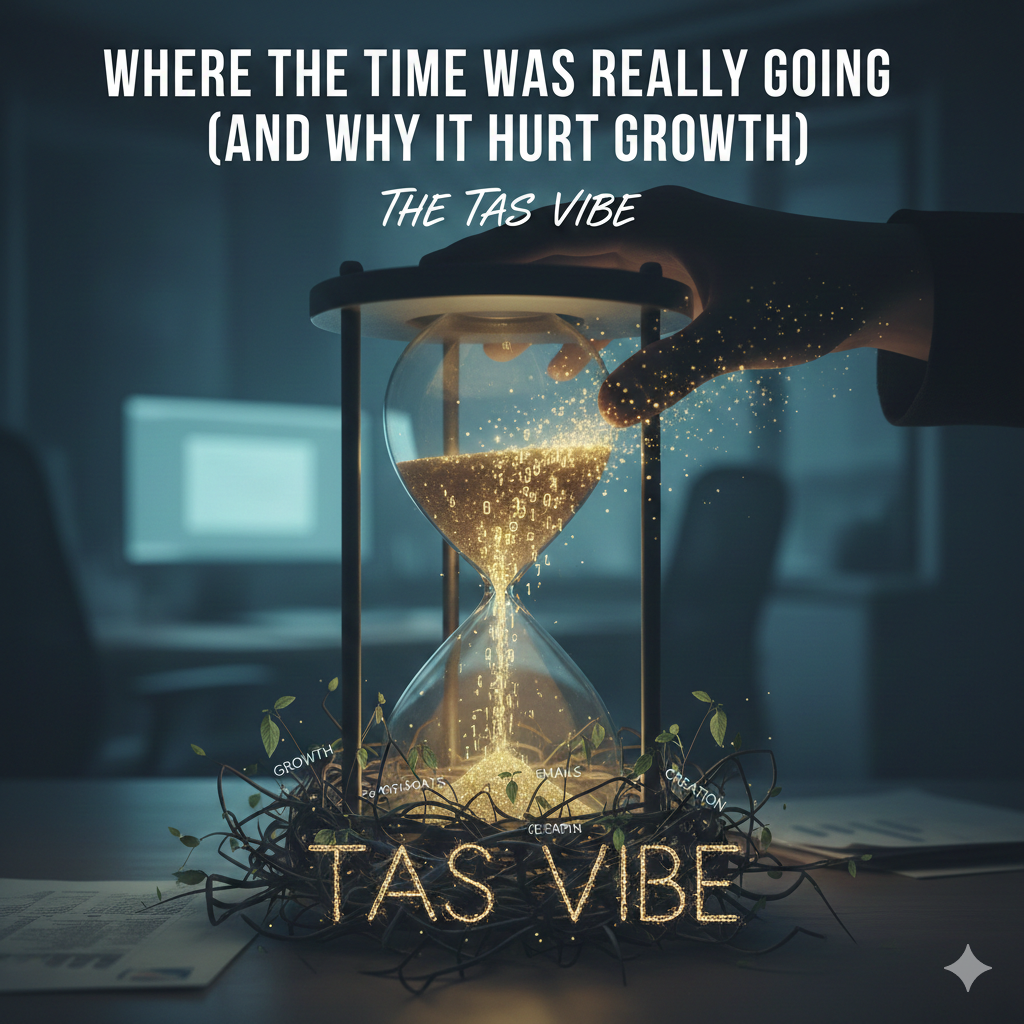

A closer audit revealed that the creator’s time wasn’t being spent on high-impact creative thinking. Instead, it was being drained by operational busywork.
🔻 The Biggest Time Drains
Here’s where those 30 hours were disappearing:
Researching and gathering source materials
Jumping between Google, blogs, tools, and notes for every articleStructuring content outlines
Rebuilding frameworks from scratch each timeDrafting first versions manually
Starting with blank pages instead of structured draftsCreating multiple content variations
Turning one blog post into:Social media snippets
Email sequences
Short-form summaries
Formatting for multiple platforms
WordPress, email tools, social platforms—all with different requirementsSEO optimization
Keywords, headings, internal links, readability checks done manually
None of these tasks were “creative breakthroughs.”
They were necessary—but not uniquely human.
The Real Problem Wasn’t Skill—It Was Process
This is a critical insight most creators miss.
The creator didn’t need to:
Write better
Learn more
Work harder
They needed a smarter system.
The bottleneck wasn’t talent—it was a manual workflow designed for a one-person operation, not a scalable content business.
That’s where AI marketing automation entered the picture.
The Automation Shift: Replacing Effort With Systems
Instead of automating creativity, the creator focused on automating friction.
The goal was simple:
Let humans handle thinking. Let AI handle repetition.
🔁 Step-by-Step Content Automation Workflow
1️AI-Powered Research & Topic Clustering
AI tools scanned top-ranking pages
Extracted patterns, subtopics, and intent
Grouped ideas into SEO-friendly clusters
⏱ Time saved: 4–5 hours/week
2️Automated Outline Generation
Instead of starting from zero:
Pre-built outline templates were created
AI generated structured drafts instantly
Each outline followed proven SEO frameworks
⏱ Time saved: 3 hours/week
3️First Draft Automation (Not Final Writing)
AI produced:
Clean, readable first drafts
Logical flow and section hierarchy
Placeholder examples and transitions
The creator edited, refined, and personalized, keeping full creative control.
⏱ Time saved: 6–8 hours/week
4️Multi-Format Content Repurposing
One blog post automatically became:
5–7 social media captions
A short email sequence
A summary for newsletters
A content brief for future videos
⏱ Time saved: 5 hours/week
5️SEO & Formatting Automation
Headings optimized automatically
Readability scores adjusted
Meta descriptions suggested
Internal link opportunities flagged
⏱ Time saved: 3–4 hours/week
The Results: From Overworked to Optimized
After implementing AI-driven content automation, the transformation was dramatic.
📉 Time Investment
Before: ~30 hours/week
After: ~5 hours/week
📈 Output & Performance
Content volume increased by 2.5x
Publishing consistency improved
SEO rankings stabilized and improved
No drop in engagement or authenticity
Most importantly, the creator reclaimed 25 hours every week—time that was reinvested into:
Strategy
Monetization
Audience building
Personal balance
Why This Matters for Small Businesses & Solopreneurs
This case study proves a powerful truth:
AI automation doesn’t replace creators—it liberates them.
For small businesses and independent creators:
Time is the scarcest resource
Consistency drives growth
Burnout kills momentum
Intelligent automation removes the invisible friction that slows everything down.
The Big Takeaway for The TAS Vibe Audience
If you’re still doing everything manually, you’re not being “authentic”—you’re being inefficient.
The future of content creation belongs to those who:
Automate the repeatable
Protect their creative energy
Build systems instead of schedules
This case study is just the beginning.
In the next module, we’ll explore how the same automation mindset transforms email marketing and customer support—turning small teams into scalable machines.
🚀 Stay tuned. The real-world results only get stronger from here.
The Automation Implementation: How an AI-Powered Content Workflow Transformed a Creator’s Entire Publishing System


In 2026, the most successful bloggers aren’t writing more content — they’re building systems that make great content inevitable.
This case study explores how one niche creator implemented a fully structured AI-powered content workflow, not to replace human creativity, but to eliminate friction, chaos, and wasted effort at every stage of the content production pipeline.
What makes this automation setup powerful isn’t the tools themselves — it’s where and how AI was applied. Instead of forcing creativity into automation, the creator automated the mechanical groundwork, freeing mental energy for insight, storytelling, and authority building.
Let’s break down the entire workflow step by step.
Stage 1: Research & Brief Generation
Turning Scattered Ideas Into Strategic Direction
Before automation, content research looked like this:
20 open browser tabs
Half-saved notes
Random keyword tools
No clear starting point
The creator’s first automation priority was research consolidation.
What Was Automated
AI tools were configured to:
Analyze top-ranking competitor content in the niche
Identify trending, low-competition, high-intent keywords
Extract patterns in headings, content length, and user intent
Surface data points, statistics, and common gaps
Instead of reacting to inspiration, the creator now started with strategic clarity.
The Real Breakthrough: Automated Content Briefs
Rather than jumping straight into writing, the system generated structured content briefs that included:
Primary and secondary SEO keywords
Search intent classification
Suggested article angle
Supporting data references
Content length recommendations
Monetization alignment (AdSense-safe structure)
This changed everything.
SEO was no longer “added later.”
SEO became the foundation.
Research stopped being scattered — it became centralized, repeatable, and scalable.
Stage 2: Outline & Structure Development
Designing Engagement Before Writing a Single Sentence
Once the brief was finalized, AI generated multiple detailed outlines based on:
Search intent
Competitor structure gaps
Readability and scannability best practices
But here’s the key difference:
👉 The creator never published AI-generated outlines untouched.
Human Refinement Was Non-Negotiable
The creator:
Adjusted section flow to match personal voice
Added contrarian or experience-based angles
Reworked introductions for curiosity and CTR
Optimized heading hierarchy for dwell time
Because AI handled the structural heavy lifting, the creator could focus on editorial strategy, not formatting.
Why This Stage Matters for SEO & CTR
Clear hierarchy improves on-page SEO
Logical flow increases average session duration
Strong subheadings improve scroll depth
Multiple outline variations allow A/B testing of content formats
Instead of guessing what structure works, the creator now tests structure systematically.
Stage 3: Initial Draft & Expansion
Escaping the Blank Page Trap
This is where most creators burn out.
Starting from a blank page is mentally expensive. Automation removed that friction entirely.
How Drafting Was Automated
AI generated:
Section-by-section draft content
Transitional paragraphs
Contextual explanations aligned with the brief
But again — this was not final content.
Where Human Creativity Took Over
The creator focused on:
Voice and tone
Storytelling and lived experience
Original insights and opinions
Nuanced explanations
Real-world examples
Because the draft already existed, editing became creative refinement, not forced productivity.
A Critical Rule: Manual Fact-Checking
One principle was strictly enforced:
All facts, claims, and data were verified manually.
AI accelerated drafting — but truth, accuracy, and credibility stayed human-owned.
This preserved:
E-E-A-T signals
Reader trust
Long-term search stability
Stage 4: Multi-Channel Adaptation
One Idea, Everywhere — Automatically
The final automation layer unlocked exponential reach.
Instead of creating new content from scratch, the system repurposed the core blog post across platforms.
Automated Adaptations Included:
LinkedIn articles with professional framing
Email newsletter versions with curiosity-driven hooks
Social media threads summarizing key insights
Short-form snippets for micro-content distribution
Each format had:
Platform-specific tone
Different opening hooks
Adjusted length and pacing
The creator simply reviewed, tweaked, and published.
The Result
One blog post turned into:
Multiple traffic sources
Cross-platform brand consistency
Increased return on creative effort
Content stopped being disposable — it became an asset system.
The Cumulative Effect: Frictionless Content at Scale
This AI-powered content automation case study proves something important:
The real power of automation isn’t speed — it’s momentum.
By removing friction at every stage:
Research became intentional
Writing became enjoyable again
Publishing became predictable
Distribution became effortless
The creator didn’t publish more by working harder.
They published more by designing a system that worked for them.
Final Takeaway for Bloggers & Solopreneurs
AI doesn’t replace creativity.
It protects it.
When automation handles:
Research chaos
Structural indecision
Drafting inertia
Repurposing fatigue
Creators are free to do what only humans can:
Think critically
Build trust
Tell stories
Create authority
And that’s exactly the philosophy behind The TAS Vibe — smart systems, real results, and content that actually moves the needle.
🚀 The Results That Changed Everything:
How AI Marketing Automation Delivered a 200% Output Increase Without Sacrificing Quality
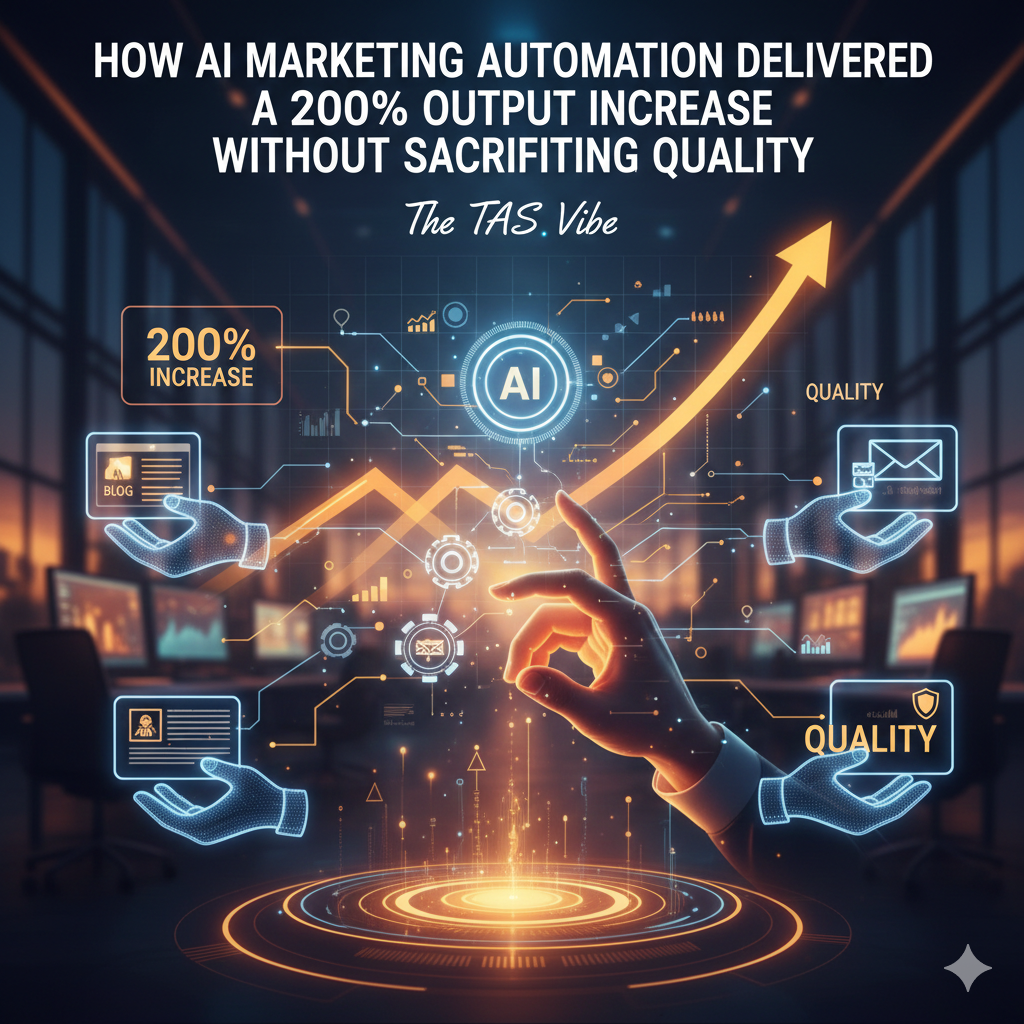
For most solopreneurs, the biggest bottleneck isn’t ideas.
It isn’t talent.
It isn’t even tools.
It’s time.
This real-world AI marketing automation case study reveals what happens when a creator stops doing everything manually and starts designing systems that scale intelligently. The outcome wasn’t just more content—it was a complete transformation of how the business operated, grew, and earned.
Let’s break down the results that made this shift undeniable.
⏱️ Time Reduction: From 30 Hours a Week to Just 5
Before automation, the creator was locked into an exhausting cycle:
Research
Writing
Editing
Publishing
Promotion
Repetition
Every single week consumed nearly 30 hours—leaving little energy for growth or strategy.
What Changed?
After implementing AI-powered workflows for research, outlining, drafting, scheduling, and cross-posting:
Weekly time investment dropped to approximately 5 hours
That’s an 83% reduction in time spent on execution
Manual bottlenecks disappeared
Decision fatigue reduced dramatically
Why This Matters
This wasn’t just about saving time—it was about unlocking capacity.
For the first time, the creator could:
Oversee multiple content projects simultaneously
Manage blog posts, newsletters, and social content in parallel
Respond personally to audience comments and messages
Build a genuine community instead of broadcasting blindly
Automation didn’t replace the creator—it freed the creator.
📈 Output Expansion: 200% More Content—Without Burnout
One of the biggest myths in content marketing is that more output equals lower quality. This case study proves the opposite—when automation is used correctly.
The Numbers Tell the Story
Monthly output increased by 200%
Content volume jumped from:
~4 in-depth posts per month
to ~12 high-value posts monthly
But here’s the surprising part 👇
Quality Didn’t Drop—It Improved
Because AI handled:
Initial research aggregation
Data structuring
Outline creation
Formatting consistency
The creator had more time to refine ideas, add insights, and deepen analysis.
Additional Gains
Publishing consistency improved dramatically
Structured automation timelines removed missed deadlines
Cross-channel presence expanded:
Blog
Email
Social platforms
All without stress, rushing, or late-night publishing marathons
Consistency—one of Google’s strongest trust signals—became effortless.
🧠 Strategic Shift: From Content Producer to Content Strategist
This was the most powerful transformation—and the least visible from the outside.
Before Automation
The creator was stuck in the role of:
“I must produce content to survive.”
After Automation
The role evolved into:
“I design content ecosystems that compound results.”
What Changed Strategically?
With execution automated, focus shifted to high-leverage thinking, including:
Deep audience research
Trend analysis and early adoption
Strategic keyword clustering
Positioning content for long-term authority
Experimentation Accelerated
Because time was no longer scarce:
New formats were tested faster
Hooks, headlines, and CTAs were optimized
Data-driven decisions replaced guesswork
Bigger Opportunities Became Possible
The creator could finally pursue work that moves the needle, such as:
Strategic partnerships
Guest collaborations
Course and digital product development
Authority-building initiatives
Automation didn’t make the work smaller—it made it smarter.
💼 Business Impact: Traffic, Growth, and Revenue Multiplied
All these internal changes led to measurable external results.
📊 Organic Traffic Growth
Content consistency + SEO alignment = results
Organic traffic increased by 45%
Older posts began ranking due to improved topical authority
Internal linking strategies became systematic instead of random
📬 Email List Growth Accelerated
With consistent newsletters and automated delivery:
Subscriber trust increased
Open rates stabilized
Engagement improved
The list grew faster because value was delivered regularly
🚀 Product Launches Became Stronger
Automation enabled:
Extended pre-launch content
Better audience warming
Multi-touch education before offers
Result:
Higher conversion rates
Less reliance on “launch stress”
More predictable outcomes
💰 Revenue Opportunities Multiplied
A larger, more engaged audience meant:
More AdSense impressions
Higher affiliate conversions
Increased demand for products and services
New monetization paths opened organically
🔑 The Core Lesson: What Automation Really Gives You
This case study proves something crucial:
Automation doesn’t replace creativity—it creates space for it.
AI marketing automation gave the creator something AI itself can never produce:
Strategic thinking
Human judgment
Authentic connection
Long-term vision
Automation handled the how, so the creator could focus on the why.
🌱 Final Takeaway for Solopreneurs
If you’re still doing everything manually, you’re not being more authentic—you’re being overworked.
This real-world AI marketing automation success story shows that:
Automation creates capacity
Capacity enables strategy
Strategy drives sustainable growth
And when done right, automation doesn’t make your brand robotic—it makes it remarkably human.
🔹 Case Study 2: Email Marketing Automation — The Conversion Multiplier
The Challenge: Email That Actually Converts
Email marketing has a reputation problem.
For many content creators, coaches, and small business owners, email isn’t seen as a growth engine—it’s seen as a chore. Something you have to do because “everyone says email marketing works.”
So they do what seems logical.
They write one email.
Send it to everyone.
Hope for the best.
And then they wonder why nothing happens.
Low open rates.
Even lower clicks.
Sales that feel random, accidental, and impossible to scale.
This case study explores how one solopreneur transformed email marketing from a weak link into their strongest conversion channel—not by writing better emails, but by automating smarter email workflows using AI-driven segmentation.
This is not theory.
This is not hype.
This is proof.
The Starting Point: A List That Looked Good on Paper
The solopreneur in this case ran an online course business in the digital skills space. On the surface, everything looked promising:
📧 Email list size: ~8,000 subscribers
📚 Multiple digital products and one flagship course
📈 Consistent traffic from content and social platforms
But the numbers behind the scenes told a different story.
❌ Email Performance Before Automation
Average open rate: 2–3%
Average click-through rate: ~0.4%
Email-driven sales: Inconsistent and minimal
Unsubscribes: Gradually increasing
Engagement: Declining month over month
The most frustrating part?
The emails themselves weren’t bad.
They were well-written, helpful, and aligned with the brand voice.
So what was going wrong?
The Real Problem: One Message for Everyone
The issue wasn’t content quality.
It was context blindness.
Every subscriber—regardless of:
how they joined the list,
what content they consumed,
whether they had purchased before,
or how engaged they were—
received the exact same emails.
This Created Three Major Issues:
Relevance was missing
Beginners received advanced offers.
Buyers received entry-level explanations.
Cold subscribers received aggressive sales emails.Trust eroded over time
When emails don’t feel personal, subscribers mentally check out—even if they don’t unsubscribe.Conversions became unpredictable
Sales happened occasionally, but there was no repeatable system behind them.
Email wasn’t broken.
The approach was.
The Shift: Treating Email Like a System, Not a Broadcast
Instead of asking:
“How do I write better emails?”
The solopreneur asked a more powerful question:
“How do I send the right email to the right person at the right time?”
That mindset change unlocked everything.
Step 1: Audience Segmentation (The Foundation)
Using AI-assisted email marketing tools, the list was segmented based on behavior, not assumptions.
Key segments included:
New subscribers (joined within 14 days)
Content-focused readers (high opens, low clicks)
Warm prospects (clicked but never purchased)
Past buyers
Inactive subscribers (no opens in 60+ days)
This instantly turned one audience into five distinct journeys.
Step 2: AI-Powered Behavioral Triggers
Instead of scheduled blasts, automation workflows were introduced.
Examples:
If a subscriber clicked a course-related link, they entered a short, value-driven sales sequence.
If someone opened but didn’t click, they received a follow-up email with a different angle.
If a subscriber ignored three consecutive emails, they were moved into a re-engagement flow.
Buyers were excluded from beginner promos and nurtured toward advanced offers.
No guesswork.
No manual tagging.
No constant list management.
The system adapted automatically.
Step 3: Contextual Personalization (Without Creepy Tactics)
This wasn’t about using first names or fake personalization.
It was about contextual relevance.
Emails referenced:
what the subscriber had already consumed,
where they were stuck,
and what the next logical step was for them.
To the subscriber, it felt like:
“This email was written exactly for me.”
To the business owner, it felt like:
“This system finally works without me babysitting it.”
The Results: When Email Becomes a Conversion Multiplier
Within 6–8 weeks, the transformation was undeniable.
📊 After Automation Implementation
Open rates: Increased to 28–35%
Click-through rates: Jumped to 4–6%
Email-driven sales: Became predictable and scalable
Unsubscribes: Dropped significantly
Time spent managing email: Reduced by over 60%
But the biggest win wasn’t just higher numbers.
It was confidence.
The solopreneur finally trusted email marketing as a reliable revenue channel—not a gamble.
Why This Worked (And Why It Scales)
This case study proves a crucial lesson:
Email marketing doesn’t fail because people hate emails.
It fails because irrelevant emails train people to ignore them.
Automation didn’t remove the human element.
It amplified it.
By combining:
smart segmentation,
AI-driven triggers,
and intentional messaging,
email became a system that worked around the clock.
The Bigger Takeaway for Solopreneurs
If you’re a creator or small business owner thinking:
“My list is too small,” or
“Email doesn’t work in my niche,”
this case study shows the truth:
👉 It’s not about list size.
👉 It’s about message relevance.
👉 It’s about systems, not broadcasts.
When email marketing is automated intelligently, it stops being a task—and starts being a conversion multiplier.
Coming Up Next on The TAS Vibe
This was just one real-world example of AI-powered automation delivering measurable results.
In the next case study, we’ll explore how customer support automation doesn’t just save time—but directly improves customer satisfaction and retention.
Because automation isn’t about replacing humans.
It’s about letting humans focus on what actually moves the needle.
The Automation Implementation: Intelligent Email Sequences That Actually Drive Results
In today’s attention-fragmented digital economy, email marketing is no longer about sending more emails — it’s about sending smarter ones. The era of batch-and-blast campaigns has officially expired. What replaces it is intelligent email automation, powered by behavior, timing, personalization, and AI-driven segmentation.
For this business, email was transformed from a generic broadcast channel into a revenue-generating, relationship-building automation engine. Below is a detailed breakdown of how each intelligent email sequence was implemented — and why it worked.
Why Intelligent Email Automation Outperforms Traditional Campaigns
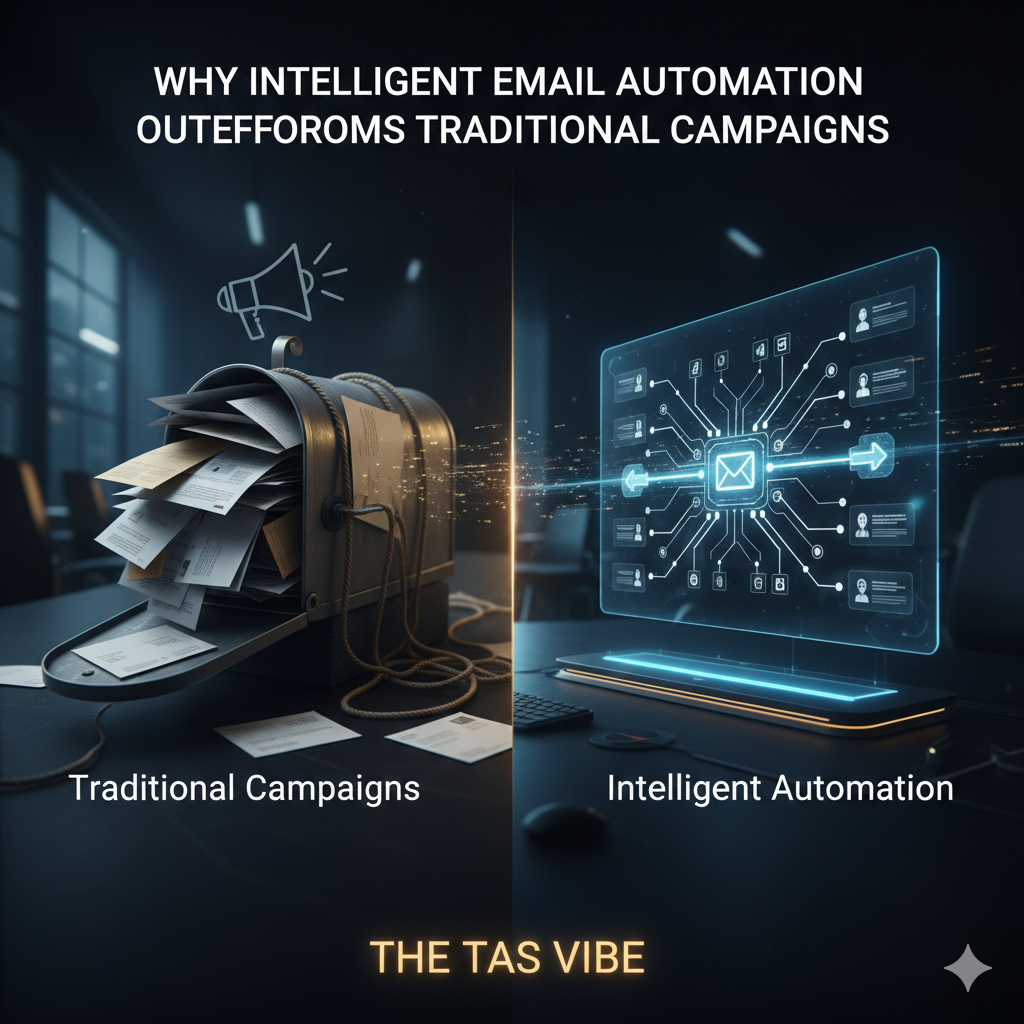
Before diving into the segments, it’s important to understand why automation wins:
Automated emails are triggered by intent, not assumptions
Messages arrive exactly when users are most receptive
Personalization goes beyond first names — it reflects behavior, context, and interest
Automation scales relationships without sacrificing relevance
Now let’s explore how this framework was built step by step.
Segment 1: Welcome Series for New Subscribers
First impressions don’t get second chances — automation makes them count
Instead of sending a single “thanks for subscribing” email, the business implemented a 5-email automated welcome sequence, triggered instantly upon signup.
How the Welcome Automation Worked
Immediate Trigger: The sequence launched the moment a user subscribed
Source-Based Personalization:
Blog readers received content-focused messaging
Webinar signups received strategy-driven emails
Lead magnet subscribers received educational follow-ups
Content Preference Mapping: Each subscriber’s interest determined which examples, case studies, and products were shown
Value First, Pitch Later:
Emails 1–3 focused on education and trust
Emails 4–5 introduced relevant products organically
Why This Sequence Converted
Welcome emails consistently outperform standard newsletters because:
Engagement is highest immediately after signup
Trust is still forming
Curiosity is at its peak
Result:
Well-structured welcome sequences historically convert at 2.8%–3%, often outperforming cold promotions by 3–5x.
Segment 2: Abandoned Cart & Browse Recovery
Recovering revenue that would’ve otherwise disappeared
Cart abandonment isn’t a failure — it’s a signal of intent. This automation captured that intent before it cooled off.
How the Recovery System Was Built
Deep Platform Integration:
The eCommerce or course platform synced directly with the email systemBehavior-Based Triggers:
Product viewed but not purchased
Item added to cart but checkout not completed
Optimized Timing Sequence:
Email 1: 1 hour after abandonment (gentle reminder)
Email 2: 24 hours later (value + reassurance)
Email 3: 48 hours later (urgency or incentive)
Dynamic Personalization:
Product images
Benefits aligned with browsing history
Smart recommendations for related items
Why It Worked So Well
Abandoned cart emails succeed because:
The user already wants the product
Objections are usually minor (timing, doubt, distraction)
Personalized reminders reduce decision friction
Result:
Abandoned cart and browse recovery sequences averaged 10%–15% conversion rates, making them one of the highest-ROI automations in the entire system.
Segment 3: Past Customer Reactivation
Turning silent subscribers into warm leads again
Instead of guessing who was inactive, AI-driven engagement scoring identified customers who hadn’t interacted for 60+ days.
The Reactivation Strategy
AI Engagement Analysis:
Clicks, opens, purchases, and browsing behavior determined inactivityBehavior-Based Messaging Paths:
Some users received educational updates
Others received exclusive offers
Others were reintroduced to new content formats
Multi-Step Sequences:
Gradual re-engagement rather than aggressive selling
Spaced messaging to avoid fatigue
Incentives With Purpose:
Discounts, bonuses, or early access — aligned with past behavior
Why This Approach Succeeded
Most inactive subscribers aren’t uninterested — they’re overwhelmed. This automation:
Respected attention limits
Delivered relevance instead of pressure
Rebuilt value before asking for action
Result:
A meaningful percentage of dormant subscribers re-entered active segments — without damaging sender reputation or unsubscribe rates.
Segment 4: Post-Purchase Nurture & Upsell
The sale is the beginning, not the end
Once a customer made a purchase, they were automatically enrolled in an 8-email post-purchase education and nurture sequence.
What the Sequence Included
Onboarding & Implementation Guidance:
Helping customers actually use what they boughtSuccess Stories & Case Studies:
Reinforcing purchase confidence and reducing buyer’s remorseStrategic Upsell Timing:
Complementary products introduced only after value was deliveredCustomer Satisfaction Triggers:
Feedback requests
Low satisfaction triggered support outreach automatically
Why This Boosted Revenue
Most businesses neglect post-purchase communication. This system:
Increased product adoption
Built trust through education
Positioned upsells as solutions, not sales pitches
Result:
Post-purchase sequences achieved 6.8% conversion rates on follow-up offers, significantly increasing customer lifetime value.
Segment 5: Engagement-Based Segmentation
One list, many experiences
Instead of treating the email list as a single audience, subscribers were continuously segmented by engagement level.
Engagement Tiers
Highly Engaged:
Frequent opens and clicks
Received premium insights, early access, and exclusive content
Moderately Engaged:
Standard educational emails with adjusted frequency
Low Engagement:
Shorter emails
Curiosity-driven subject lines
Content designed to re-spark interest
Automation Logic Behind the Scenes
Engagement scores updated dynamically
Frequency automatically reduced for low-engagement users
Content depth increased for high-intent subscribers
No manual list management required
Why This Protects Deliverability & CTR
Reduces spam complaints
Improves open rates across the board
Aligns content intensity with attention capacity
Result:
Higher CTRs, better inbox placement, and a healthier email ecosystem overall.
Final Takeaway: Automation That Feels Human Wins
This intelligent email automation framework proves one thing clearly:
The future of email marketing isn’t louder — it’s smarter.
By replacing batch-and-blast campaigns with behavior-driven, AI-enhanced sequences, the business achieved:
Higher conversions
Better customer experiences
Increased lifetime value
Scalable personalization without burnout
For creators, solopreneurs, and digital businesses reading The TAS Vibe, this is the blueprint:
Automate the timing, personalize the message, and always lead with value.
The Results: ~30% Conversion Rate Increase with Predictable Revenue
At The TAS Vibe, we don’t publish theory for theory’s sake. We publish proof. Real workflows. Real numbers. And most importantly—repeatable results.
This case study breaks down how AI-powered email marketing automation transformed an underperforming email list into a predictable, scalable revenue engine. No list growth hacks. No spammy tactics. Just better segmentation, smarter personalization, and automated timing.
What follows is a deep dive into the performance metrics, revenue impact, operational efficiency, and strategic outcomes—and why this transformation matters for any solopreneur, creator, or digital business in 2026.
Performance Metrics: From Ignored Emails to High-Intent Clicks
Before automation, the email system looked familiar:
Generic broadcasts
One-size-fits-all messaging
Manual scheduling
Guesswork instead of insights
After implementing AI-driven segmentation and automated workflows, the numbers told a completely different story.
📈 Open Rates: 12% → 22% (83% Improvement)
An open rate jump of this magnitude doesn’t come from better subject lines alone.
What changed:
AI analyzed past engagement behavior (opens, clicks, inactivity windows)
Subscribers were grouped by interest, intent, and lifecycle stage
Emails were sent based on engagement probability, not fixed calendars
The result? Emails arrived when subscribers were most likely to care—not when it was convenient for the sender.
🔗 Click Rates: 0.4% → 3.2% (700% Increase)
This was the most dramatic improvement.
Previously, links were ignored because the content wasn’t aligned with reader intent. AI-powered personalization flipped that dynamic.
Key drivers:
Dynamic content blocks based on subscriber behavior
CTA alignment with user awareness stage
Automated follow-ups triggered by partial engagement
Instead of asking everyone to do the same thing, each subscriber saw the most relevant next step.
🛒 Conversion Rates: 0.08% → 0.9% (Up to 1.42% in Automated Flows)
Manual campaigns rarely crossed 0.1% conversion.
Automated flows told a different story:
Core email-driven sales stabilized at 0.9%
High-intent automated sequences consistently hit 1.2%–1.42%
Why? Because automation removed pressure and replaced it with timing precision.
👋 Welcome Sequences: 2.8%–3% Conversion (Consistent)
The welcome sequence became the highest-performing asset.
New subscribers were:
Educated before being sold
Segmented within the first 72 hours
Routed into personalized journeys based on actions
This alone created compounding gains across the entire funnel.
Revenue Impact: Predictable Growth Without More Traffic
The most important insight?
Revenue increased without increasing list size.
💰 Email Revenue: +30% in 90 Days
Within the first three months:
Email-driven revenue rose by approximately 30%
Growth came from better positioning, not more promotions
🔁 Predictable Monthly Revenue: $2,400 → $3,150
Before automation:
Revenue spikes were inconsistent
Forecasting was unreliable
After automation:
Monthly email revenue stabilized around $3,150
Income became forecastable instead of hopeful
Predictability changed how offers, launches, and promotions were planned.
🎯 Lower Customer Acquisition Cost (CAC)
AI-driven reactivation flows revived:
Cold subscribers
Past buyers who hadn’t engaged recently
Leads previously considered “dead”
Recovering already-acquired users meant:
Lower ad dependency
Higher ROI on existing traffic
Reduced CAC without sacrificing growth
📩 Revenue Per Email: +25% (Same List)
No increase in volume. No aggressive sending.
Just higher relevance per message.
AI ensured every email earned its place in the inbox.
Operational Efficiency: Less Work, Better Results
Automation didn’t just increase revenue—it gave time back.
⏱️ Time Spent: 4 Hours/Week → 30 Minutes/Week
Manual workflows were replaced by:
Trigger-based sequences
Self-optimizing segmentation
AI-assisted testing
Once set up, the system required minimal maintenance.
🧠 Smarter Segmentation (Without Manual Rules)
Instead of static tags, AI continuously analyzed:
Engagement frequency
Content preferences
Buying signals
Segments updated automatically as behavior changed.
🧪 Continuous A/B Testing at Scale
Automation allowed:
Ongoing subject line testing
CTA variations inside sequences
Timing optimization without manual resets
Testing velocity increased dramatically—with zero extra workload.
🎯 Personalization at Full Scale
What was once impossible manually became standard:
Personalized messaging for thousands of subscribers
Context-aware follow-ups
Lifecycle-based content delivery
Automation didn’t remove the human touch—it amplified it.
Strategic Outcomes: A Business That Runs Without Constant Effort
Beyond metrics, the real transformation was strategic.
🚀 Campaigns Without Burnout
Offers and promotions could run:
On schedule
Without last-minute scrambling
Without manual micromanagement
🔍 Full Visibility Into the Customer Journey
For the first time, it was clear:
Where subscribers dropped off
What content moved them forward
When they were ready to buy
This clarity improved every future decision.
⏰ Strategic Upsells (Not Opportunistic)
AI identified the right moment to present upsells—based on behavior, not assumptions.
This increased average order value without hurting trust.
🧹 Healthier Email List
Inactive segments were:
Re-engaged intelligently
Cleaned when necessary
Managed without damaging deliverability
List health improved—and so did inbox placement.
The Core Truth This Case Study Reveals
This email marketing automation success story proves one essential principle:
Segmentation and personalization multiply effectiveness far more than volume ever could.
Sending more emails doesn’t grow revenue. Sending the right message, to the right person, at the right time does.
AI didn’t replace strategy—it enforced it consistently.
And that’s why the results weren’t just impressive…
They were predictable.
Published exclusively on The TAS Vibe — where AI automation meets real-world results.
🔹 Case Study 3: Customer Support Automation — Scaling Support Without Growth Costs
How One Online Business Eliminated Support Bottlenecks Using AI (Without Hiring a Single New Agent)
Introduction: When Growth Becomes a Hidden Threat
Every online business dreams of growth—more users, more customers, more revenue. But what most founders don’t anticipate is the silent tax of success: customer support overload.
This case study explores how a fast-growing online service business transformed its customer support system using AI-powered automation, reduced response times by over 80%, and scaled operations without increasing payroll costs.
If you’re a solopreneur, SaaS founder, blogger, or digital service provider, this real-world example proves that AI customer support automation isn’t optional anymore—it’s a competitive advantage.
🚨 The Challenge: Support Demand Exceeding Team Capacity
As the business gained traction, daily customer inquiries surged across:
Website live chat
Email support
Social media DMs
Post-purchase onboarding questions
The support team consisted of just two full-time agents, both highly skilled—but human.
The Pain Points Were Clear:
⏱ Average response time: 8–14 hours
📩 Inbox backlog growing daily
😠 Increasing customer frustration
⭐ Negative reviews mentioning “slow support”
💸 Hiring more staff would drastically reduce profit margins
Despite solid products and strong marketing, customer experience was becoming the weakest link.
The leadership team faced a brutal choice:
Hire more agents and sacrifice profitability
Or maintain lean operations and risk customer churn
Neither option felt sustainable.
🧠 The Insight: Most Support Questions Were Repetitive
Before making any changes, the business conducted a 30-day audit of incoming support tickets.
The results were eye-opening:
🔍 Support Ticket Breakdown
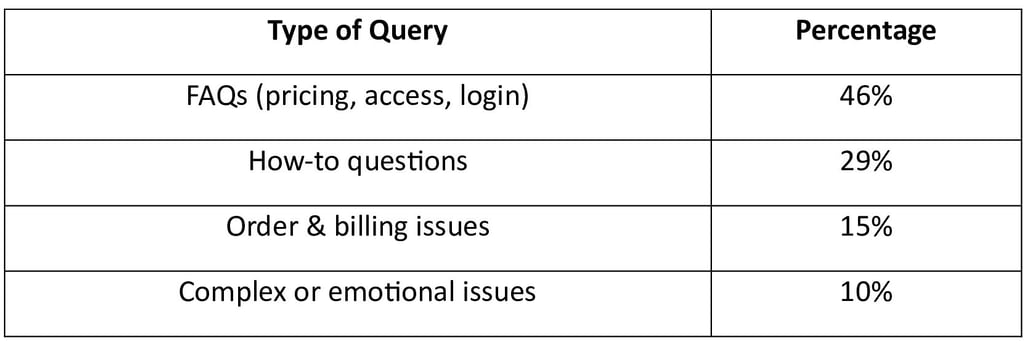
👉 90% of inquiries didn’t require a human agent.
This insight changed everything.
The problem wasn’t customer volume—it was inefficient support delivery.
🤖 The Solution: AI-Powered Customer Support Automation
Instead of expanding the team, the business invested in a smart AI chatbot system, trained specifically on their:
Knowledge base
FAQs
Product documentation
Past support conversations
Core Tools Used (Tool-Agnostic Strategy)
Rather than relying on one brand, the automation stack focused on capabilities:
NLP-based AI chatbot (trained on real data)
Automated ticket categorization
Human handoff triggers
Multichannel integration (website + email)
Analytics dashboard for continuous improvement
This approach ensured flexibility, scalability, and future-proofing.
⚙️ How the Automation System Worked (Step-by-Step)
1️⃣ Instant AI Chat Response (24/7 Availability)
Customers now received immediate responses—even at midnight.
AI greeted users conversationally
Asked clarifying questions
Delivered accurate, context-aware answers
No scripts. No robotic tone. Just fast, helpful support.
2️⃣ Smart Issue Classification
The AI automatically categorized queries into:
Self-resolvable
Requires human review
Urgent escalation
This prevented agents from wasting time on simple questions.
3️⃣ Human Escalation Only When Needed
For complex issues (billing disputes, refunds, emotional complaints), the system:
Collected full context
Tagged urgency level
Routed to the right human agent
Agents now handled quality conversations, not repetitive tasks.
4️⃣ Continuous Learning Loop
Every resolved interaction trained the AI further.
The result?
📈 Smarter responses
📉 Fewer escalations
💬 Better customer conversations over time
📊 The Results: Measurable, Immediate, Game-Changing
Within 45 days of implementation, the impact was undeniable.
🚀 Performance Metrics
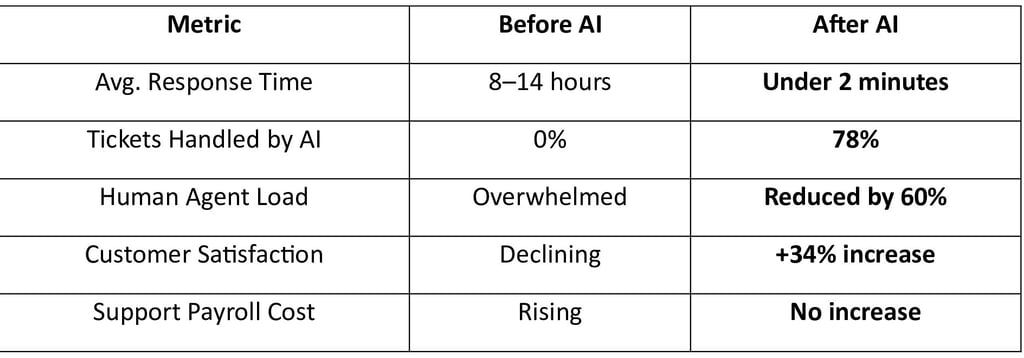
💬 Customer Feedback Shifted Dramatically
Before automation:
“Great service, but support takes forever.”
After automation:
“Support replies instantly—impressive!”
“Best customer service I’ve experienced from a small business.”
Positive reviews started compounding, boosting brand trust and conversion rates.
💰 The Financial Impact: Scaling Without Growth Costs
Let’s talk numbers.
💼 Hiring 2 more agents would cost ~$60,000/year
🤖 AI automation cost: a fraction of one salary
📈 ROI achieved in under 90 days
The business didn’t just save money—it redirected resources toward growth, marketing, and product improvement.
🧠 Key Lessons for Online Businesses & Solopreneurs
✅ Lesson 1: Customer Support Is a Growth Lever
Fast, intelligent support increases retention, reviews, and referrals.
✅ Lesson 2: AI Doesn’t Replace Humans—It Protects Them
Agents now focus on empathy and problem-solving, not copy-paste replies.
✅ Lesson 3: Automation Scales Instantly
Your support capacity should never limit your growth again.
🔮 Why This Matters in 2026 and Beyond
Customers now expect:
Instant responses
24/7 availability
Personalized support
Businesses that fail to automate will fall behind—not because their product is bad, but because their experience is slow.
AI-powered customer support automation is no longer “advanced.”
It’s baseline.
🔗 Final Thoughts from The TAS Vibe
This case study proves one powerful truth:
You don’t scale customer support by hiring more people—you scale it by building smarter systems.
If you’re running an online business and struggling with support overload, AI automation isn’t a luxury—it’s your next strategic move.
In the upcoming module, we’ll explore how to design these systems step-by-step, even if you’re a solo founder with zero technical background.
Stay tuned.
Growth without burnout is possible. 🚀
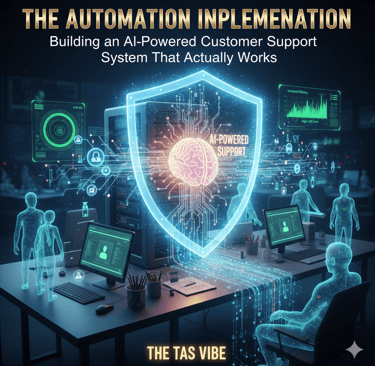
The Automation Implementation: Building an AI-Powered Customer Support System That Actually Works

In 2026, customer support is no longer about answering tickets faster—it’s about answering smarter.
As digital businesses scale globally, customer expectations have shifted dramatically. Users now expect instant responses, contextual understanding, and consistent support quality, regardless of time zones or workload spikes. This is where AI-powered support automation moves from “nice to have” to mission-critical.
In this real-world implementation, the business didn’t rely on a single AI tool. Instead, it deployed a multi-layered AI customer support automation system, designed to combine speed, intelligence, and human empathy—without overwhelming the support team.
Let’s break down how this four-layer automation stack worked in practice—and why it delivered measurable results.
Why a Multi-Layered AI Support System Matters
Most businesses fail with AI support because they try to replace humans instead of empowering them.
This implementation took a different approach:
AI handled volume and repetition
Humans handled complexity and emotion
Automation reduced friction, not relationships
The result? Faster resolutions, lower ticket volume, happier customers, and a less burned-out support team.
Layer 1: Intelligent AI Chatbot (The First Line of Defense)
The foundation of the system was an intelligent AI chatbot, acting as the first response layer across all customer touchpoints.
24/7 Availability Across Channels
The chatbot was live on:
Website chat
Email support
Live chat widgets
This ensured customers received instant responses, even outside business hours—eliminating the frustration of waiting for “office hours.”
Trained on Real Business Knowledge
Rather than generic AI responses, the chatbot was:
Trained on the company’s FAQ
Integrated with the internal knowledge base
Fed with real customer interaction scenarios
This made responses accurate, contextual, and aligned with the brand voice.
Intent-Based Natural Language Understanding
Thanks to advanced natural language processing (NLP), the chatbot didn’t rely on keywords alone. It understood:
What the customer was asking
Why they were asking
What outcome they were likely expecting
This allowed it to handle variations in phrasing naturally—just like a human would.
Automated Resolution of Routine Queries
The chatbot successfully handled:
Account and billing questions
Order tracking
Feature explanations
Password resets
Common troubleshooting issues
By resolving routine queries instantly, it removed 60–70% of incoming support tickets before they ever reached a human.
Layer 2: Smart Routing for Complex Issues
No AI system should pretend it can solve everything—and this one didn’t.
When the chatbot detected:
Emotional frustration
Technical complexity
Multi-step issues
Policy exceptions
…it intelligently escalated the issue.
Context-Aware Escalation
Instead of dumping the customer into a human queue, the system passed along:
Full conversation history
Customer intent summary
Attempted solutions
Relevant account or product data
This eliminated the dreaded:
“Please explain your issue again.”
Skill-Based Agent Assignment
Smart routing rules ensured tickets were assigned based on:
Agent expertise
Product knowledge
Issue category
Priority level
This dramatically improved first-contact resolution rates and reduced internal back-and-forth.
Layer 3: AI-Suggested Responses (Agent Augmentation)
This is where productivity skyrocketed.
Instead of typing replies from scratch, human agents received AI-generated response suggestions tailored to each ticket.
One-Click Efficiency
Agents could:
Send suggested replies instantly
Edit and personalize them
Adjust tone based on customer emotion
This cut response drafting time by more than 40%.
Focus on Empathy, Not Typing
With AI handling structure and accuracy, agents focused on:
Tone matching
Personalization
Building trust
De-escalation when needed
This preserved the human touch, while still moving fast.
Consistency Without Scripted Replies
Because suggestions were context-aware, responses remained:
On-brand
Accurate
Consistent across agents
No more robotic copy-paste replies.
Layer 4: Knowledge Base Integration (The Silent Support Hero)
The final layer quietly reduced workload without customers even noticing.
Searchable, Customer-Facing Knowledge Base
The business revamped its knowledge base to be:
Fully indexed
Easy to search
Written in plain, human language
Smart Article Linking
The chatbot dynamically linked:
Relevant help articles
Step-by-step guides
Visual walkthroughs
Customers often solved their own problems without creating a ticket.
Fewer Tickets, Better Experiences
This resulted in:
Lower ticket volume
Higher customer satisfaction
Better SEO visibility for help articles
A well-structured knowledge base became both a support tool and a traffic asset.
The Real-World Impact of This Automation Stack
By combining all four layers, the business achieved:
Faster first response times
Higher resolution rates
Reduced support costs
Happier customers
More productive support agents
Scalable global support without scaling headcount
Most importantly, automation didn’t replace humans—it amplified them.
Final Thoughts: Automation That Respects the Customer
AI customer support automation only works when it’s designed around real user behavior, not hype.
This multi-layered implementation proves that:
Speed and empathy can coexist
AI and humans are strongest together
Smart systems reduce friction, not trust
For modern digital businesses, this isn’t the future—it’s the new baseline.
And for brands that get it right, customer support stops being a cost center and becomes a competitive advantage.
The Results: 80% of Requests Handled Without Human Intervention
When people hear “AI customer support automation,” the first fear that usually comes to mind is cold, robotic service that frustrates customers and alienates teams. This case study proves the opposite. Implemented correctly, AI doesn’t replace human support—it removes friction, accelerates response times, and allows real people to do their best work.
This real-world example shows what happens when an AI-powered support system is aligned with business goals, customer expectations, and operational reality.
Support Metrics: From Bottleneck to Instant Response
Before automation, customer support followed a familiar pattern: overflowing inboxes, delayed replies, and exhausted agents constantly reacting instead of resolving. After implementation, the transformation was measurable and immediate.
AI chatbot performance became the backbone of the support operation:
The AI chatbot successfully handled approximately 80% of routine support inquiries end-to-end, without human involvement.
First response time dropped dramatically—from a frustrating 8–14 hours to an average of just 47 seconds.
Customers received instant answers to common questions, such as billing, onboarding steps, account access, and basic troubleshooting.
For more complex issues requiring human judgment, agent response time fell from 4+ hours to just 18 minutes on average.
This shift alone changed how customers perceived the brand. Support was no longer something they waited for—it was something they relied on.
Operational Impact: Support Teams Finally Breathing Again
Automation didn’t reduce the importance of human agents—it elevated it.
With routine questions handled automatically:
The support team could focus exclusively on complex, high-value customer issues that truly required empathy, reasoning, and experience.
Average handle time per ticket decreased by 38%, because agents weren’t switching between trivial and complex requests.
Support ticket volume decreased measurably, as many issues were fully resolved through self-service without ever becoming tickets.
The containment rate reached a 70% baseline, meaning seven out of ten issues were solved without escalation.
Instead of fighting fires, the support team began solving problems—and that distinction matters more than most businesses realize.
Customer Experience: Speed Became the Brand Advantage
One of the biggest myths about automation is that customers dislike it. In reality, customers dislike waiting—not automation.
Once AI support was introduced:
First contact resolution improved from 45% to 78%, meaning most customers got what they needed in a single interaction.
Customer satisfaction scores increased, even though total inquiry volume rose significantly.
Response speed transformed from a recurring complaint into a clear competitive advantage.
24/7 support availability became the norm, without overtime costs or burnout.
Customers didn’t feel ignored—they felt supported. And that emotional shift directly influenced loyalty and trust.
Financial Results: Scaling Without Scaling Costs
The financial impact of AI customer support automation is where skepticism usually disappears.
Despite a 150% increase in the customer base:
Overall support costs remained flat.
The chatbot platform reached ROI break-even within just six weeks.
The business avoided hiring two additional support staff, translating to an estimated $120,000+ in annual savings.
Higher satisfaction led to improved retention and lower churn, compounding revenue gains over time.
This wasn’t cost-cutting—it was cost containment paired with growth enablement.
The Real Lesson: AI Multiplies Human Capability
This AI customer support automation case study makes one thing clear:
Intelligent automation isn’t about replacing humans—it’s about multiplying what good humans can accomplish.
When AI handles the repetitive, mechanical, and predictable work, humans gain the freedom to do what machines can’t: build relationships, solve nuanced problems, and create meaningful customer experiences.
How These Case Studies Connect to Your Situation
These examples aren’t from massive corporations with unlimited budgets. They represent real-world AI marketing automation case studies for small businesses and solopreneurs—people building with limited time, money, and margin for error.
Each faced constraints that likely feel very familiar:
Time poverty – endless tasks, not enough hours
Revenue unpredictability – growth without unsustainable hiring
Customer satisfaction pressure – wanting to help customers better with limited resources
Across all cases, the pattern was consistent:
Strategic automation removes friction from mechanical processes, freeing human capacity for strategic, creative, and relationship-focused work.
That is the true promise of AI—not efficiency for its own sake, but freedom to focus on what actually moves the needle.
If you’re building a business, a brand, or a solo operation, the question is no longer whether to automate. It’s where automation can give you the biggest leverage—without sacrificing the human experience your customers value most.
This is the kind of AI that doesn’t just save time—it changes how your business grows.
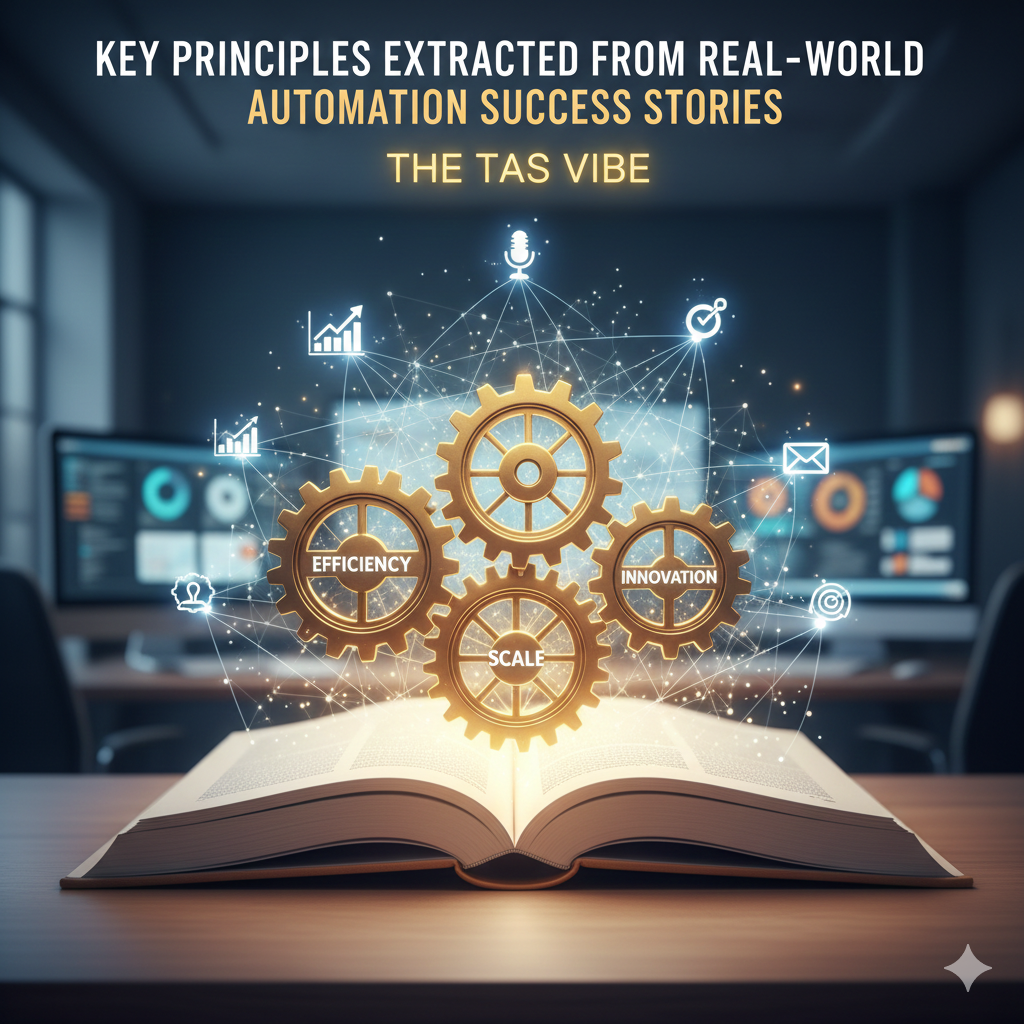
Key Principles Extracted From Real-World Automation Success Stories
What Actually Works—and Why Most Automations Fail
In the AI automation gold rush, many creators, marketers, and solopreneurs fall into the same trap: automate everything, everywhere, all at once. The promise sounds irresistible—less work, more scale, instant growth.
But real-world results tell a different story.
When we closely analyze successful AI automation case studies across content marketing, email marketing, and customer support, a clear pattern emerges. The winners didn’t chase flashy tools or full replacement of humans. Instead, they followed a few grounded, repeatable principles.
These principles are not theoretical. They are extracted from implementations that increased engagement, improved conversion rates, reduced burnout, and strengthened customer trust.
Let’s break them down.
Principle 1: Automate the Foundation, Not the Relationship
This is the most misunderstood—and most important—principle.
What Successful Teams Automated
In every high-performing case study, automation was applied to:
Market and keyword research
Content briefs and outlines
Email segmentation and scheduling
Ticket categorization and routing
Knowledge base indexing
These are repetitive, time-consuming, low-empathy tasks.
What They Refused to Automate
They did not automate:
Final content voice and storytelling
Sensitive email replies
Customer escalation handling
Strategic decisions
Relationship-building conversations
Why? Because audiences can feel authenticity.
No matter how advanced AI becomes, people can sense when they’re talking to a script instead of a human who understands context, emotion, and nuance.
The Real Win
Automation worked best when it:
Removed mental clutter
Freed human time
Enabled creators and teams to show up more authentically
👉 Automation that enables human connection scales trust.
Automation that replaces it destroys trust.
Principle 2: Data Integration Is Everything
Most automation failures don’t happen because of bad AI.
They happen because systems don’t talk to each other.
What the Winning Setups Had in Common
Successful implementations didn’t rely on one “powerful” tool. Instead, they focused on integration, such as:
CRM connected to email platforms
Website behavior synced with chatbot responses
Knowledge bases feeding customer support automation
Analytics dashboards pulling from multiple sources
In these cases, AI didn’t magically become smarter.
It simply had better context.
Why Integration Beats Tool Sophistication
A basic automation tool with clean, connected data will always outperform:
Expensive AI
Advanced features
Fancy dashboards
…if those tools are working in isolation.
👉 Automation power comes from data flow, not feature lists.
Principle 3: Measurement Precedes Optimization
Every successful case study followed the same quiet rule:
Measure first. Optimize later.
What They Measured Before Automation
Before making changes, teams tracked:
Email open and click-through rates
Content production time
Customer response time
Support resolution rates
Conversion drop-off points
This created a baseline reality check.
Why This Matters
Without measurement:
You don’t know what’s broken
You don’t know what’s improving
You can’t justify scaling
Many failed automations looked “busy” but produced no measurable gain because there was nothing to compare against.
👉 What gets measured improves dramatically.
What isn’t measured becomes noise.
Principle 4: Gradual Implementation Beats Big Launches
None of the successful cases attempted a full automation overhaul.
Instead, they followed a crawl → walk → scale approach.
How They Rolled It Out
Automated one function (e.g., email onboarding)
Observed results for weeks, not days
Adjusted prompts, logic, and workflows
Documented learnings
Expanded to the next area
Why This Approach Wins
Lower risk
Easier debugging
Faster team adoption
Real proof of ROI
Less audience disruption
Big-bang launches feel exciting—but they also amplify mistakes.
👉 Slow automation builds fast confidence.
Principle 5: Humans Remain the Decision-Makers
This principle separates sustainable automation from short-lived hacks.
What AI Handled
Across all successful cases, AI was used for:
Suggestions
Drafts
Predictions
Categorization
Routine responses
What Humans Controlled
Humans retained authority over:
Final messaging
Customer-facing decisions
Brand voice
Ethical judgment
Relationship escalation
AI acted as a co-pilot, not a CEO.
This preserved:
Accountability
Trust
Brand integrity
Emotional intelligence
👉 AI accelerates decisions. Humans own them.
The Bigger Lesson for Solopreneurs & Digital Creators
If there’s one meta-lesson from these real-world results, it’s this:
Automation is not about replacing people.
It’s about protecting human creativity, judgment, and connection.
When used correctly:
Automation reduces burnout
Improves consistency
Unlocks deeper strategy
Strengthens audience trust
When used incorrectly:
It alienates audiences
Damages brand credibility
Creates fragile systems
Final Takeaway for The TAS Vibe Audience
If you’re building AI automation workflows that actually move the needle:
Start with foundations, not faces
Connect systems before buying tools
Measure before optimizing
Scale slowly and deliberately
Keep humans in control
Do this, and automation becomes a growth multiplier, not a brand liability.
Common AI Automation Implementation Mistakes These Successful Companies Avoided
(And How You Can Avoid Them Too)
AI automation is often marketed as a magic switch—flip it on, and suddenly your business runs faster, cheaper, and smarter. But real-world success stories tell a very different story.
Behind every “automation win” you see online, there are dozens of failed implementations that wasted time, money, and customer trust. What separates the winners from the rest isn’t the tools they used—it’s the mistakes they intentionally avoided.
In this article, we break down the five most common automation implementation mistakes and explain how high-performing companies sidestepped them. If you’re serious about automation that actually moves the needle, this is where clarity begins.
Mistake 1: Automating Before Truly Understanding the Process
Why This Mistake Is So Common
Many businesses rush into automation because:
A competitor is using it
A tool promises instant efficiency
A consultant recommends “automation first”
But automation does not create understanding—it requires it.
What Successful Companies Did Differently
The companies behind strong automation case studies spent weeks mapping their existing workflows before automating anything. They asked questions like:
What exactly happens at each step?
Where do delays or errors occur?
Which steps require human judgment?
Only after documenting and stress-testing their processes did they automate.
Key Insight
You can’t automate clarity. You must earn it first.
Automation should be the final step, not the starting point.
Mistake 2: Expecting Automation to Fix a Bad Process
The Harsh Truth About Automation
Automation is a multiplier.
Good process → Excellent results at scale
Bad process → Disaster at scale
Many failed automation projects didn’t fail technically—they failed strategically.
Real-World Example
A poorly written email sequence sent manually causes minor damage.
That same sequence, automated and sent to 50,000 users, destroys:
Open rates
Brand trust
Deliverability
Revenue potential
What Winning Companies Did
Before automating:
They rewrote messaging
Simplified steps
Removed unnecessary approvals
Improved customer journeys
Automation came after optimization, not before.
Key Insight
Fix the process first. Automate excellence—not chaos.
Mistake 3: Neglecting System Integration (The Silent Killer)
Why Integration Is Often Ignored
Businesses often stack tools quickly:
CRM
Email marketing
Customer support
Analytics
Payment systems
Each tool works well individually, but without integration, automation creates:
Data silos
Duplicate work
Conflicting information
Broken customer experiences
What Successful Companies Did Right
High-performing teams planned integration before implementation:
Defined a single source of truth
Ensured data flowed cleanly between systems
Used APIs, webhooks, or middleware wisely
They treated automation as an ecosystem, not a collection of tools.
Key Insight
Automation without integration doesn’t save time—it hides problems.
Mistake 4: Removing the Human Touch from Customer Interactions
The Automation Overreach Problem
Some companies over-automate in the name of efficiency:
Fully automated support responses
Zero human follow-up
Cold, robotic interactions
Customers feel this immediately—and they don’t forgive it easily.
What Smart Companies Understood
The most successful implementations:
Used automation to support humans, not replace them
Automated routing, tagging, and prioritization
Kept human intervention at emotional or critical moments
Customers could feel the difference.
Human + Automation = Trust at Scale
Automation handled:
Speed
Consistency
Availability
Humans handled:
Empathy
Judgment
Relationship-building
Key Insight
Automation should amplify humanity, not erase it.
Mistake 5: The “Set It and Forget It” Mentality
Why This Mindset Fails
Markets change. Customers evolve. Platforms update.
But many businesses treat automation like a one-time setup.
The result?
Declining performance
Missed opportunities
Outdated messaging
Reduced ROI over time
What Successful Companies Did Instead
They treated automation as a living system:
Monitored metrics weekly
A/B tested workflows
Adjusted triggers and conditions
Refined based on real user behavior
Automation became an ongoing advantage, not a frozen asset.
Key Insight
Automation is not a destination. It’s a process of continuous refinement.
Final Takeaway: Why These Companies Actually Won
The companies that succeeded with automation didn’t chase hype—they chased understanding.
They:
Respected process before tools
Fixed fundamentals before scaling
Integrated systems thoughtfully
Preserved human connection
Continuously optimized performance
That’s why their automation didn’t just save time—it built trust, revenue, and long-term growth.
The TAS Vibe Perspective
At The TAS Vibe, we believe AI automation isn’t about replacing effort—it’s about redirecting it toward impact. When implemented thoughtfully, automation becomes a strategic asset that compounds over time.
In the next module, we’ll explore real-world results and live case studies that prove these principles in action—no hype, no theory, just execution that works.
The Specific Tools Behind Modern AI Automations (And How They Actually Work Together)
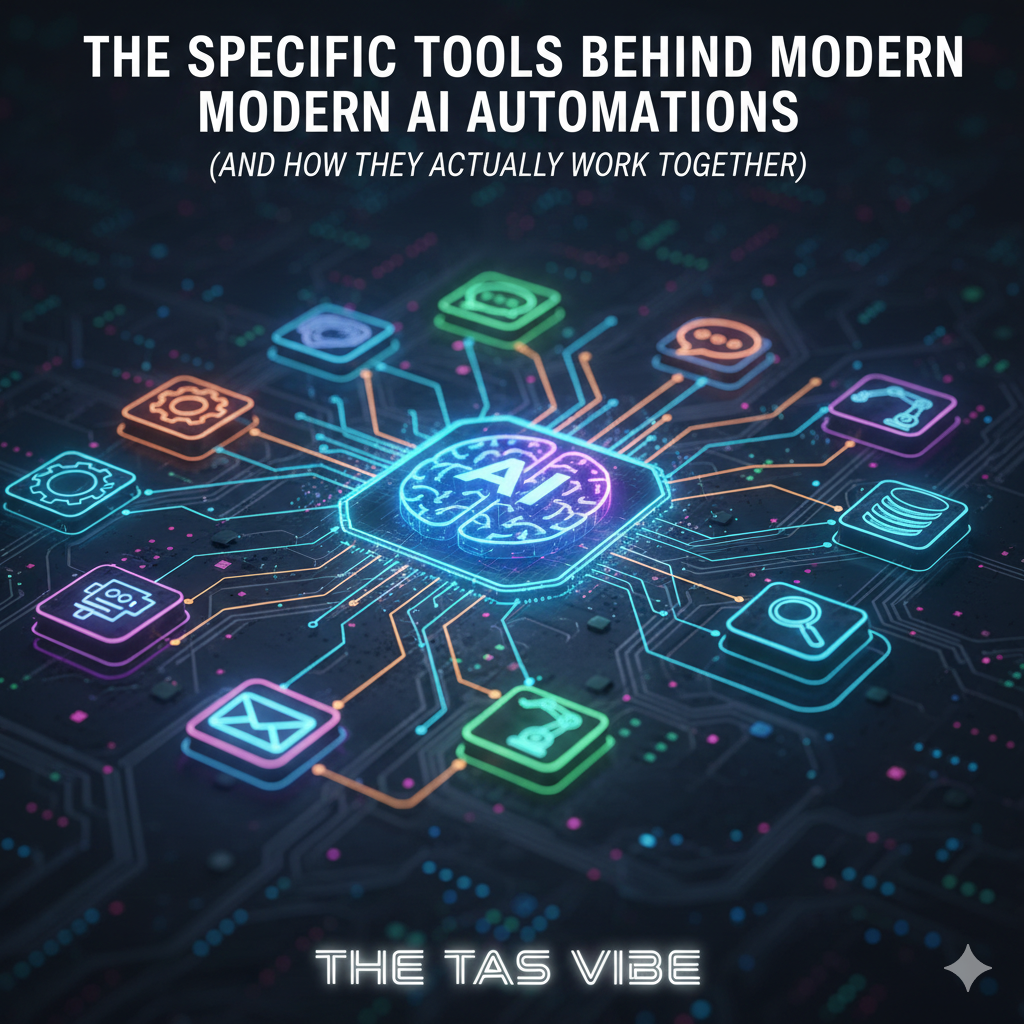
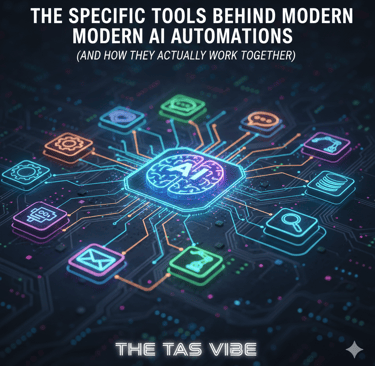
Note: Multiple platforms can achieve similar outcomes. The tools discussed below are representative examples based on real-world usage patterns, not endorsements.
AI automation is no longer about chasing shiny tools. In 2026, the real winners are creators and businesses who understand how specific tools work together as systems, not silos.
Behind every “set-and-forget” content engine, high-converting email funnel, or lightning-fast customer support experience lies a carefully designed automation stack.
Let’s break down the exact tools powering these automations, why they matter, and how they fit into a scalable, future-proof workflow.
🧠 Content Automation Tools: Turning Ideas into Published Assets at Scale
Content automation doesn’t mean replacing human creativity. It means removing friction—so your energy goes into strategy, voice, and insight, not repetition.
✍️ AI Writing & Ideation Engines
(ChatGPT, Claude, Gemini)
These tools serve as the thinking layer of content automation.
They excel at:
Brainstorming topic clusters and long-tail keywords
Creating first-draft blog posts, scripts, or outlines
Rewriting content for tone, clarity, or platform fit
Summarizing research into digestible insights
Smart usage tip:
The best creators don’t publish AI output directly. They use AI as a drafting partner, then layer in personal experience, brand voice, and original insights—this is where uniqueness and SEO authority are born.
🔁 Workflow Automation Platforms
(Zapier or Make / Integromat)
If AI writes the content, Zapier or Make moves it through your system.
These tools automate actions like:
Sending AI-generated drafts to Notion or Google Docs
Updating content status automatically (Idea → Draft → Review → Published)
Triggering notifications when a post is ready for editing
Syncing published content with social or email tools
Why this matters:
Without automation, content pipelines break under scale. With it, one idea can flow effortlessly from concept to publication.
📋 Content Structuring & Planning
(Notion + Structured Templates)
Notion acts as the central nervous system of content automation.
Used correctly, it:
Stores standardized content briefs
Enforces consistent structure across writers and AI tools
Houses outlines, SEO metadata, and publishing checklists
Becomes the single source of truth for content operations
Pro insight:
Templates reduce decision fatigue. When structure is predefined, creativity flows faster—and quality becomes repeatable.
📊 Editorial Management & Calendars
(Airtable)
Airtable bridges the gap between spreadsheets and databases, making it ideal for managing content at scale.
It helps you:
Track content status visually (Kanban, calendar, grid)
Manage multi-author or multi-platform publishing
Store performance metrics alongside content assets
Identify bottlenecks in your production workflow
Why serious bloggers love Airtable:
Because it turns content chaos into a predictable system—essential for monetization and AdSense growth.
📧 Email Automation Tools: From Broadcasts to Intelligent Conversations
Email is no longer about newsletters—it’s about behavior-driven communication.
The tools below power email systems that feel personal, timely, and relevant.
🧩 Advanced Segmentation & Automation
(Klaviyo or Omnisend)
These platforms are built for event-based email marketing.
They allow you to:
Segment users based on actions, not just demographics
Trigger emails from site behavior, purchases, or clicks
Build multi-step automation flows (welcome, nurture, re-engagement)
Optimize send times and content dynamically
Key advantage:
Highly relevant emails = higher open rates, better CTR, and stronger lifetime value.
🧠 CRM-Driven Email Ecosystems
(HubSpot)
HubSpot combines CRM, email marketing, automation, and analytics into one unified platform.
It’s ideal for:
Tracking the full customer journey
Aligning email campaigns with sales or lead pipelines
Automating follow-ups based on lifecycle stages
Measuring ROI across channels
Best suited for:
Creators and businesses transitioning from “content” to content-led growth engines.
✨ Creator-First Email Platforms
(ConvertKit or Substack)
Designed for bloggers, educators, and independent creators, these tools prioritize simplicity without sacrificing automation.
They support:
Tag-based subscriber organization
Automated sequences and drip campaigns
Paid newsletters and memberships
Seamless integration with landing pages
Why creators prefer them:
Less complexity, faster setup, and tools aligned with personal brands—not enterprise sales teams.
🔗 Custom Webhooks & APIs
(Advanced Automation Layer)
For those ready to go deeper, custom webhooks and APIs unlock true personalization.
They enable:
Triggering emails from non-standard events
Connecting proprietary tools or apps
Real-time data exchange between platforms
Fully custom automation logic
This is where automation becomes unfairly powerful.
💬 Customer Support Automation: Always-On, Without Losing the Human Touch


Modern customer support blends AI efficiency with human empathy.
🤖 Chatbots & Live Support Integration
(Tidio or Intercom)
These tools sit on your website or app and act as the first line of interaction.
They:
Answer common questions instantly
Route complex issues to human agents
Capture leads while providing support
Operate 24/7 without burnout
Result:
Faster responses, happier users, and lower support costs.
🎫 Ticketing Systems & Knowledge Bases
(Help Scout or Zendesk)
For structured support operations, ticketing systems are essential.
They help:
Organize customer queries by priority and category
Maintain searchable knowledge bases
Track resolution times and agent performance
Ensure no request falls through the cracks
Pro tip:
A strong knowledge base reduces tickets before they’re even created.
🧠 AI Conversation Platforms
(ChatBot.com or Drift)
These tools focus on natural, guided conversations, not scripted replies.
They excel at:
Understanding user intent
Asking clarifying questions
Qualifying leads through dialogue
Providing context-aware responses
The difference:
Users feel assisted—not automated.
🔁 Support Workflow Automation
(Zapier for Support Tasks)
Zapier quietly handles the repetitive backend work, such as:
Auto-assigning tickets
Tagging issues based on keywords
Logging conversations in CRMs
Triggering follow-up emails after resolution
Outcome:
Support teams focus on solving problems, not managing tools.
🚀 Final Takeaway: Tools Don’t Win—Systems Do
The real magic isn’t ChatGPT, Zapier, or HubSpot individually.
It’s how these tools are connected into intelligent workflows that:
Reduce manual effort
Increase consistency
Improve user experience
Scale without burnout
For creators and businesses following The TAS Vibe philosophy, automation isn’t about doing less—it’s about doing what matters most, more effectively.
And this is only the foundation.
👉 In the next module, we’ll explore real-world case studies showing exactly how these tools drive measurable growth, revenue, and freedom.
Stay tuned—because this is where automation proves itself.
Before You Implement AI Automation: 5 Critical Questions You Must Answer
AI marketing automation is powerful—but power without strategy is chaos.
Many solopreneurs, bloggers, coaches, and digital founders rush into automation expecting instant freedom, only to end up with broken workflows, confusing dashboards, and more work than before. The difference between automation that scales your business and automation that sabotages it lies in pre-implementation clarity.
Before you deploy a single tool or connect your first workflow, you must answer the following five questions honestly. These questions are not optional—they are the foundation of profitable, sustainable automation.
Let’s break them down.
1. Which Process Would Deliver the Highest ROI If Automated?
Automation is not about doing everything—it’s about doing the right thing first.
Not all tasks are created equal. Some processes happen once a month. Others repeat dozens of times a day. Automation should begin where time savings are frequent, measurable, and compounding.
High-ROI Automation Candidates:
Lead capture and follow-up sequences
Email segmentation and personalization
Content repurposing (blogs → emails → social posts)
Customer support triage and FAQs
Reporting and performance tracking
Low-ROI Automation Traps:
One-off creative tasks
Processes that are constantly changing
Workflows with unclear outcomes
Rule of thumb:
If a task happens often, takes mental energy, and doesn’t require deep creativity—it’s a prime automation candidate.
Start with one process that gives you the biggest time or revenue return, then expand strategically.
2. What Data Integration Is Required?
Automation only works when your systems talk to each other.
Many automation failures don’t happen because AI is “bad”—they happen because tools are poorly connected. When data doesn’t flow cleanly, automation creates friction instead of freedom.
Ask Yourself:
Which tools need to exchange data? (CRM, email, analytics, payment, support)
Where does data originate—and where should it end up?
Is data syncing real-time or delayed?
What happens if one tool fails or changes APIs?
Common Integration Mistakes:
Over-connecting unnecessary tools
Relying on fragile one-way integrations
Ignoring data formatting mismatches
Weak integrations increase manual fixes, duplicate data, and decision errors. Strong integrations reduce cognitive load and improve accuracy.
Pro tip: Fewer, well-integrated tools outperform large, fragmented tech stacks every time.
3. How Will You Measure Success?
If you don’t define success before automation, you’ll never know if it worked.
One of the biggest mistakes marketers make is automating first and measuring later. This leads to impressive-looking dashboards that don’t actually improve the business.
Define Your Baseline Metrics First:
Before automation, capture:
Time spent on the task
Error rates or quality issues
Conversion rates
Revenue impact
Customer satisfaction indicators
Then Decide What “Better” Means:
Is success fewer hours worked?
Higher response speed?
Increased revenue per lead?
Reduced churn?
Improved consistency?
Automation should serve one primary goal, not ten vague ones.
Clarity converts automation into leverage.
4. Who Maintains This System?
Automation is not “set and forget.” It’s “set, monitor, refine.”
AI systems need:
Monitoring
Updates
Prompt optimization
Tool upgrades
Workflow adjustments as your business evolves
If no one owns the system, it will degrade over time.
Decide in Advance:
Who checks workflows weekly?
Who handles failures or edge cases?
How often will prompts and logic be reviewed?
What’s the fallback if a tool stops working?
Even solo creators must budget time—not just money—for maintenance.
Automation replaces repetitive labor, not responsibility.
5. What’s the Worst-Case Scenario If This Automation Fails?
Smart automation includes a safety net.
Every system can fail. The question is not if, but how badly. Your job is to make sure failure is inconvenient—not catastrophic.
Build Contingency Plans:
Manual overrides for critical workflows
Backup data storage
Human review for high-risk outputs
Clear alerts when automations break
Avoid Dangerous Dependencies:
Don’t automate core revenue flows without safeguards
Don’t rely on one tool for everything
Don’t remove human oversight from sensitive decisions
Automation should strengthen your position—not create single points of failure.
Transition to Module 5: From Automation to Optimization
At this point, you’ve seen real proof that AI marketing automation works—when implemented strategically.
The case studies demonstrated:
Significant efficiency gains
Measurable revenue growth
Improved customer satisfaction
Reduced workload and burnout
But here’s the truth most courses never tell you:
Knowing that automation works is not the same as knowing which metrics actually matter.
This is where many businesses stall.
Coming Next: Module 5 — KPIs: What to Track & Optimize
In Module 5, we move from execution to mastery.
You’ll learn:
Which metrics actually predict long-term business success (hint: it’s not vanity metrics)
How to design measurement systems that guide smarter decisions
Real-world benchmarks so you know whether your automation is thriving or underperforming
The exact dashboards and tracking methods high-performing automation users rely on daily
How to iterate using data—not guesswork, hope, or hype
Automation is the engine.
Metrics are the steering wheel.
In the next module, you’ll learn how to steer—with precision, confidence, and control.
Welcome to the growth phase. 🚀
About The Author: Rishab Anand
Rishab Anand is the visionary founder behind The TAS Vibe, a content and strategy platform designed to empower solopreneurs and small business owners to harness technology and automation for sustainable growth. With a deep understanding of identity and access management (IAM), marketing automation, and digital entrepreneurship, Rishab merges technical expertise with practical business insights, helping independent entrepreneurs implement systems that are both powerful and manageable.
Over the years, Rishab has personally scaled content operations while maintaining quality standards—a rare balance in the fast-paced world of digital entrepreneurship. He has guided dozens of creators and small business owners through similar transformations, fully aware of the unique challenges solopreneurs face when implementing automation systems. His philosophy is simple yet profound: prioritize strategy over tools, meaningful measurement over vanity metrics, and human judgment over blind automation.
At The TAS Vibe, Rishab’s mission is to demystify automation for solopreneurs. He ensures that independent entrepreneurs can compete with larger businesses without losing their authentic voice or values. From case studies and implementation guides to strategy frameworks, everything is designed specifically for solopreneurs—not the enterprise market.
When he isn’t exploring the latest automation platforms or interviewing founders about their growth journeys, Rishab actively helps businesses audit existing systems, identify automation opportunities, and implement changes in a systematic way. His approach is grounded in the belief that the best automation is the one you actually use consistently, which is why his frameworks prioritize simplicity, sustainability, and practicality over complexity.
For those ready to explore automation without being overwhelmed by it, The TAS Vibe is a treasure trove of insights and actionable strategies. As Rishab often emphasizes, smart automation should free you to do your best work—not trap you in endless system management.
You can explore more about Rishab’s work and philosophy at The TAS Vibe, where the principle is clear: automation done right enhances your business, amplifies your efforts, and gives you the freedom to focus on what makes your venture unique.
Key Takeaways for Solopreneurs
These aren’t hypothetical future possibilities—they are current realities for content creators, solopreneurs, and small business owners who implement AI marketing automation strategically.
Measurable Outcomes Are Within Reach
Automation isn’t about flashy tools or complex systems. It’s about implementing strategies that produce results you can track, measure, and replicate at any stage of your business.Work Smarter, Not Harder
The transformation isn’t in clocking more hours—it’s in working differently. Let automation handle the repetitive tasks that machines excel at, while you focus on the creative and strategic aspects that make your business unique.Your Own Case Study Awaits
Every solopreneur has the potential to generate meaningful results through smart automation. With the right frameworks, tracking methods, and iterative optimization, your business can become its own success story. Module 5 of The TAS Vibe’s program provides the tools to measure, refine, and optimize these outcomes systematically.
Final Thought:
Rishab Anand’s philosophy is simple but powerful: automation should amplify your impact, not replace your judgment. By combining technical knowledge, strategic thinking, and actionable guidance, The TAS Vibe equips solopreneurs to achieve sustainable growth, maintain authenticity, and create measurable, repeatable success in the digital world.
Video Overview
Connect
Stay updated with us
Follow
Reach
+91 7044641537
© 2025. All rights reserved.