Will AI Replace Jobs? The TAS Vibe Deep Dive
Will AI Replace Jobs? Explore expert insights on automation, future careers, AI risks and opportunities, and how workers can adapt in 2026 and beyond. Today
AI ETHICS ISSUES 2026
Andrew - The TAS Vibe
1/30/20264 min read
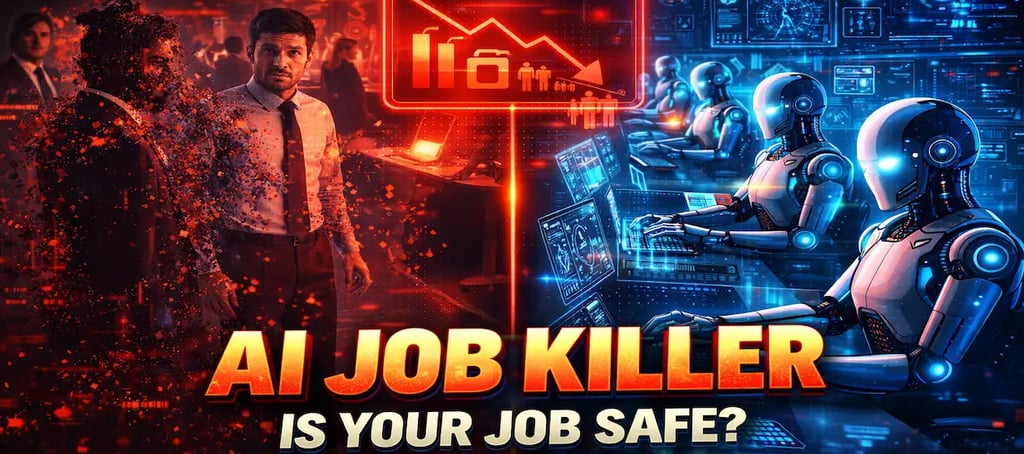
AI Job Killer 2026: 5 Jobs Vanishing Fast—Is Yours on the Chop List?
You’re mid-scroll on LinkedIn, heart sinking as you spot another "restructuring" announcement. That burning question—"Will AI replace my job?"—isn't just a search query anymore; it’s a global anxiety. I’ve seen friends in routine roles from London to Mumbai lose sleep over the 2026 job market, but the reality on the ground isn't just about "deletion"—it’s about a messy, difficult evolution.
Take a call center I visited in Manchester last month. They didn't just "replace" 150 people with bots. I spoke with Sarah, a veteran rep there, who told me the hardest part wasn't the software itself—it was the weird, taxing task of "teaching" the bot how to sound genuinely sorry. She spent weeks trying to get the machine to nail the phrase, "I'm so sorry to hear that, let's get this sorted," without it sounding like a tin can.
Sarah didn't lose her career; she became an AI Overseer. This is the truth about AI job displacement in 2026: The role changes, but the human "empathy gap" remains your greatest job security.
Key Takeaway: AI isn't wiping out work—it's rewriting the job description. If your daily tasks feel like a "loop," it's time to start learning the tools that automate that loop.
The Reality of AI and Unemployment 2026


While headlines scream about a "job-pocalypse," the latest data from McKinsey tells a more nuanced story. Automation is currently "zapping" roughly 25% of repetitive tasks, not firing people wholesale. Data entry, telemarketing, and basic coding are shrinking because bots are simply better at predictability.
However, the Bureau of Labor Statistics is forecasting nearly 2 million new roles centered on AI job security. These aren't just technical roles; we’re talking about ethics watchdogs and Prompt Engineers who bridge the gap between human intent and machine output. Fear drives the clicks, but the data shows that "Human + AI" teams are consistently outperforming solo workers.
The 5 Industries Facing the Sharpest Shifts


Based on the World Economic Forum’s 2026 update, these sectors are seeing the most radical "pruning":
Customer Service: Just like the Manchester case, companies like Verizon are trimming frontline staff by the thousands, only to rehire smaller, specialized teams for "escalations" that require human judgment.
Junior Content & Design: Entry-level drafting is being swallowed by generative tools. If you’re a freelancer, you’ve likely felt the "race to the bottom" on pricing unless you offer strategy, not just "output."
Accounting & Admin: In Australia, new auto-matching software has gutted traditional invoice processing. If your job is "matching Column A to Column B," the bot has already won.
Legal Research: Junior associates are no longer spending 80 hours a week on document review; AI does it in seconds, shifting the "human value" to courtroom strategy and client empathy.
Retail Logistics: Automated sorting in warehouses is relentless. The physical "shifter" role is vanishing, replaced by "system technicians."
If you're worried, look toward healthcare, trades, or psychology. These thrive on "snap judgments" and physical dexterity—things a Grok 4.1 model still struggles to replicate. For more on how machines are watching our moves, check out our piece on AI Surveillance Ethics.
Why "Human Skills" are the New Currency


It’s not a "Humans vs. Machines" showdown; it’s a partnership. A design firm I work with in London recently moved their junior artists into "Creative Lead" roles. They stopped drawing the lines and started directing the vision.
Even in Bangalore’s high-pressure IT scene, the shift is visible. After tools like DeepSeek started crushing basic debugging, entry-level coding jobs took a hit. But those who pivoted to "AI Co-Pilot" training actually saw a 20% pay bump. They moved from "writing code" to "auditing code."
Frequently asked questions
Is AI replacing jobs entirely?
No—it’s replacing tasks. Most "layoffs" are actually shifts in required skills.
What is the most secure job in 2026?
Anything requiring high empathy or complex physical movement—therapists, plumbers, and high-level managers.
How do I stay safe?
Don't fight the tool; master it. Use free resources like Coursera to understand the Future of Human Jobs.
About the Author: Andrew
Andrew has spent a decade tracking the intersection of tech and labor. From Silicon Valley boardrooms to coffee shops in the Cotswolds, he focuses on the "human side" of the digital shift. After pivoting from a data analyst role to a career scout, he now helps professionals navigate the 2026 workplace with a "human-first" philosophy.
Subscribe to our Blogging Channel The TAS Vibe
Connect
Stay updated with us
Follow
Reach
+91 7044641537
Copyright: © 2026 The TAS Vibe. All rights reserved.