
Nemotron 3 Super API pricing vs GPT-5: Guide
Compare Nemotron 3 Super API pricing vs GPT-5 to find the most cost-effective solution. Our 2026 guide breaks down token costs, speed, and overall efficiency.
BEST AI TOOLS FOR BUSINESS AUTOMATION ROADMAP 2026
Agni - The TAS Vibe
3/14/20265 min read
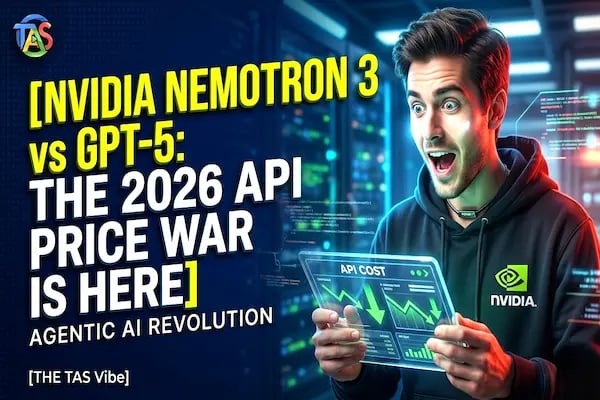
The "March 2026 AI Price War" has officially kicked off. If you’re a dev or a founder, you’ve likely felt the sting of "API Burnout." Watching your OpenAI dashboard bleed credits while GPT-5 handles basic data cleaning is a gut-punch to your margins. But the landscape just shifted. NVIDIA’s Blackwell chips have hit the mainstream, and with them, the Nemotron 3 Super API pricing vs GPT-5 debate has become the most critical calculation for your startup’s survival.
Here is the bottom line: You no longer have to choose between "smart and expensive" or "dumb and cheap." We are entering the era of economic scaling. NVIDIA is pitching a "4 experts for the price of 1" model that is forcing everyone—from indie hackers to enterprise architects—to recalculate their API burn rates.
The Economic Shift: Nemotron 3 Super Latent MoE vs GPT-5.4 Token Cost
The biggest buzz on X and Reddit right now centers on NVIDIA’s Latent Mixture of Experts (MoE) architecture. Traditional MoE models (like GPT-4) activate specific "experts" for different tasks, but Nemotron 3 Super takes this further. By using "Latent" experts, the model reduces the active parameter count during inference without dropping its IQ.
When comparing Nemotron 3 Super Latent MoE vs GPT-5.4 token cost, the math is startling. NVIDIA is leveraging its vertical integration (owning the chips and the software) to undercut OpenAI significantly.
For 2026 startups, this is the "Agentic Burn" factor. If you have an autonomous agent running 24/7 loops—scraping, reasoning, and executing—that $1.40 difference per million tokens isn't just pocket change; it’s the difference between a profitable SaaS and a venture-backed fire sale.
Hardware Synergy: NVIDIA Blackwell NVFP4 Precision vs GPT-5 API Latency
In the AI world, speed isn't just a luxury—it’s currency. This is where the hardware-software stack truly shines. NVIDIA Blackwell NVFP4 precision vs GPT-5 API latency is the new benchmark for performance-obsessed devs.
Blackwell chips utilize NVFP4 (4-bit floating point) precision. This allows the Nemotron 3 Super to maintain high accuracy while moving data through the GPU at 4x the speed of previous generations.
Instant Response: Nemotron’s Time-To-First-Token (TTFT) is nearly imperceptible.
The "Thinking Pause": GPT-5, due to its massive parameter density, often has a noticeable "thinking" lag before it starts streaming.
Developer Tip: If your agentic loop requires 10 back-and-forth calls to complete a task, a 500ms latency on GPT-5 becomes a 5-second delay for the user. Nemotron’s Blackwell-optimized speed ensures your agents feel "live."
[Featured Snippet] How much does the Nemotron 3 Super API cost compared to GPT-5?
As of March 2026, Nemotron 3 Super API pricing is significantly more aggressive than GPT-5, costing approximately 75% to 90% less per million tokens. While GPT-5 remains the industry leader for complex, zero-shot reasoning and creative synthesis, Nemotron 3 Super uses a Latent MoE architecture optimized specifically for NVIDIA Blackwell hardware. This provides a "4-for-1" efficiency ratio, allowing for higher Agentic AI throughput at a fraction of the cost required for OpenAI’s flagship models.
Context is the New RAM: Nemotron 1M Context Window vs GPT-5.4 400k Benchmark
We’ve all seen the "Forgetfulness Gap." You feed an LLM a massive codebase, and by the time you ask a question about the index.js file, it’s already hallucinating because it ran out of "memory."
In the Nemotron 1M context window vs GPT-5.4 400k benchmark, NVIDIA has taken the lead for heavy-duty developers.
The 1M Advantage: You can now drop an entire GitHub repository or a 1,000-page legal transcript into a single prompt.
Needle-in-a-Haystack: Recent tests show Nemotron 3 Super maintains 99% retrieval accuracy even at the 900k token mark.
For the 15-35 demographic—the builders and the "solopreneurs"—context is essentially the new RAM. Being able to keep your entire project in the model's "active memory" without constant RAG (Retrieval-Augmented Generation) overhead is a massive productivity hack.
The "Build vs. Buy" Debate: OpenRouter GPT-5.4 Pricing vs Nemotron 3 Super Self-Hosting
A "Sovereign AI" movement is peaking. On X and Reddit, the debate isn't just about price; it's about ownership.
The Case for GPT-5 (Buy): Using OpenRouter GPT-5.4 pricing models is easy. You pay for what you use, and you get the world's smartest model via a simple API key.
The Case for Nemotron (Build): With the release of the RTX 6090 and Blackwell consumer cards, Nemotron 3 Super self-hosting has become a reality for prosumers.
The ROI on a $2,500 local NVIDIA rig can be realized in less than six months if you are heavy on API usage. Plus, you get total data privacy—no more worrying about your proprietary code training the next version of a closed-source model.
Performance Benchmarking: Agentic AI Throughput: Nemotron 3 Super vs GPT-5 Pro
It’s time to stop asking "Who is smarter?" and start asking "Who is the better worker?"
Agentic AI throughput: Nemotron 3 Super vs GPT-5 Pro is measured in Tokens per Second per Dollar (TPS/$).
GPT-5 Pro: The "Architect." Use it for the high-level strategy, the initial code structure, and the complex logic.
Nemotron 3 Super: The "Worker." Use it for the thousands of repetitive tasks: unit testing, documentation, data formatting, and log monitoring.
NVIDIA is winning the "Worker" role because it can handle 10x the volume for the same price. If you want to see how these tools fit into a broader business strategy, check out our Best AI Tools for Business Automation Roadmap 2026.
E-E-A-T: Expert Insights & Real-World Implementation
Case Study: A San Francisco-based dev shop recently transitioned their "Support Agent" backend. Originally, they spent $4,800/month on GPT-5 API calls. By switching the routine classification and response tasks to Nemotron 3 Super (keeping GPT-5 only for "escalations"), they slashed their monthly bill to $650.
Common Myth: "Cheap AI is dumb AI."
Reality: We are seeing "Specialized Intelligence." A model doesn't need to know how to write a poem in the style of 18th-century French poets to help you debug a React component.
Pro-Tip 1: Use a "Router" pattern. Send complex prompts to GPT-5 and high-volume, structured tasks to Nemotron. It’s the ultimate "Hybrid Stack" strategy.
Which Model Should You Choose?
The decision comes down to your specific workflow.
Choose GPT-5 If: You need world-class zero-shot logic, high-stakes creative synthesis, or complex reasoning where cost is secondary to accuracy.
Choose Nemotron 3 Super If: You are scaling autonomous agents, need a 1M token context window, or are building high-volume applications where API margins are tight.
For a deeper dive into the specific feature sets, revisit our Nemotron 3 Super API pricing vs GPT-5: Full Comparison.
🚀 Pro-Tips for the AI Power User
Pro-Tip 2: Monitor your "System Prompt" overhead. With Nemotron's 1M window, you can include your entire company's SOPs as a permanent prefix without ever hitting a limit.
Pro-Tip 3: Check for NVIDIA Inception credits. Many early-stage startups can get Nemotron API access for free through NVIDIA's developer program, making the "Price War" a total landslide.
CTA: Ready to optimize your agentic stack? Subscribe to our Future of AI newsletter below to receive a free Python script that auto-routes your tasks between Nemotron and GPT-5 based on real-time cost-density!
Get in touch
Subscribe to our blogging Channel "The TAS Vibe"
Connect
Stay updated with us
Follow
Reach
+91 7044641537
Copyright: © 2026 The TAS Vibe. All rights reserved.