
AI Policing in 2026: Helpful or Dangerous?
Explore how AI policing is transforming law enforcement in 2026, weighing public safety benefits against privacy risks, ethics, and real global case studies
AI ETHICS ISSUES 2026
The TAS Vibe
1/29/20265 min read
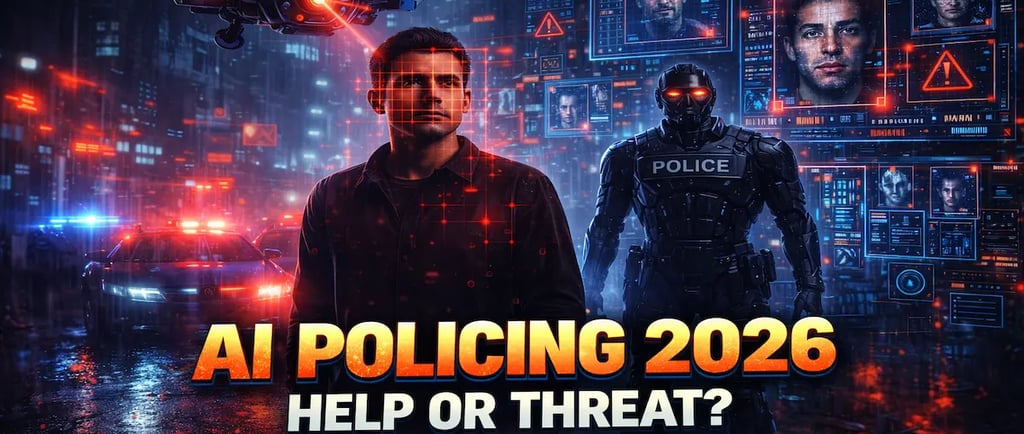
AI in Policing 2026: Helpful or Dangerous
Across America, Europe, Russia, Asia and Australia, a silent transformation is unfolding inside police control rooms. Screens no longer show only CCTV feeds. They display predictive maps, facial recognition alerts, behavioural flags and real-time analytics generated by AI in law enforcement systems. What once sounded like science fiction is now part of daily AI policing operations.
Supporters say this is the biggest leap in AI public safety technology in decades. Critics warn it may become the most powerful surveillance framework ever created. The global AI policing debate in 2026 is no longer theoretical — it is happening on streets, in courtrooms, and in policy rooms.
Watch this quick video for an overview before reading.
🎧 Prefer listening? Play the audio version below.
This mind map gives you a quick overview of the concepts covered below.
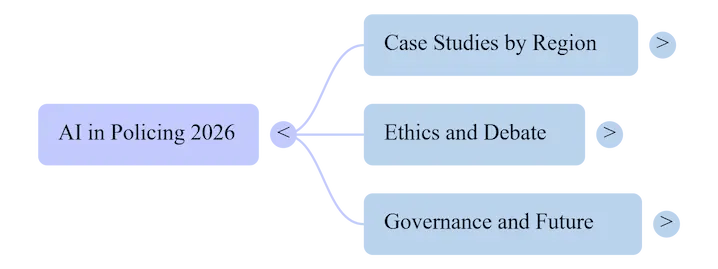
AI in Policing 2026 Case Studies
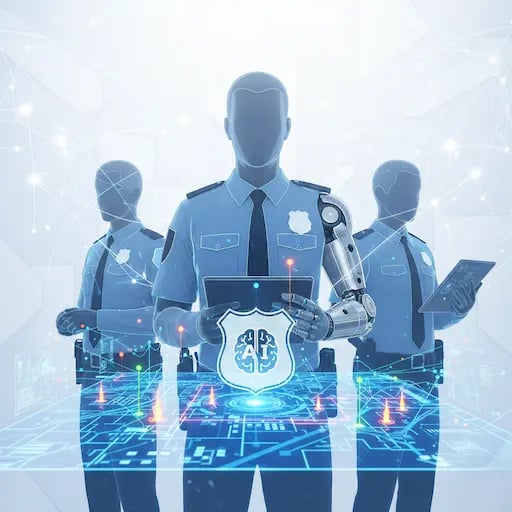
United States – Predictive Policing and Crime Mapping
Several US cities have expanded the use of predictive policing software that analyses years of crime data to forecast where incidents are likely to occur. These AI crime prediction models help departments deploy patrols more efficiently.
Problem: In earlier trials, communities raised concerns that historical data reflected past bias, leading to over-policing in certain neighbourhoods. Questions around predictive policing accuracy became central to public discussion.
Solution: Cities introduced transparency dashboards, third-party audits, and community review boards to monitor how algorithms recommend patrol zones.
United Kingdom – Police AI Chatbots and Surveillance Integration
The UK made headlines with the deployment of Police AI chatbots to handle non-emergency queries and integrate reports into central databases. Simultaneously, trials of AI police surveillance linked facial recognition to live CCTV.
Problem: Civil liberty groups argued that AI facial recognition policing could identify innocent citizens without consent.
Solution: Strict usage policies were introduced, requiring human confirmation before action, alongside public signage informing citizens where AI systems operate.
India – AI Law Enforcement Tools for Public Safety
India’s fast digital modernisation has led to the adoption of AI law enforcement tools for crowd monitoring during festivals, traffic control, and missing person identification.
Problem: Concerns emerged regarding data storage and AI law enforcement privacy issues.
Solution: Data retention limits and encrypted storage protocols were mandated, alongside new digital privacy guidelines.
AI Surveillance Ethics Debate
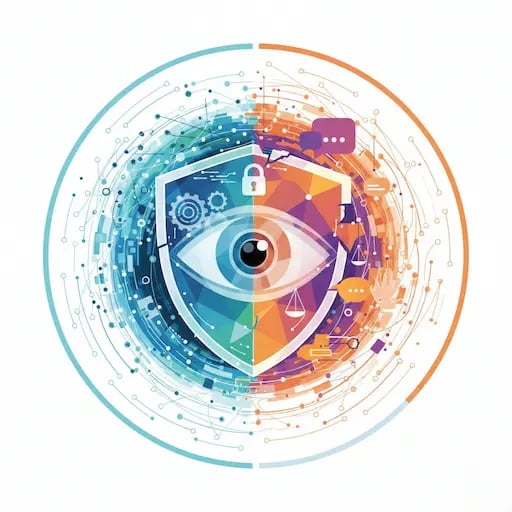
The rise of AI policing ethics as a research and policy topic shows how seriously governments are taking this issue. The key question is not whether AI should be used, but how far it should be allowed to go.
Is it acceptable for AI to scan every face in a crowd?
Should algorithms decide who looks “suspicious”?
Can machines fairly assess human behaviour?
This ethical tension fuels searches around AI policing risks 2026 and AI policing advantages 2026 across the US, UK and EU. Under the EU AI Act and similar frameworks worldwide, law enforcement AI is now classified as “high risk”, requiring regulation, audits and accountability.
Public Safety vs Privacy


This is where the debate becomes personal.
Supporters argue:
Faster suspect identification
Better resource deployment
Reduced crime response time
Improved missing persons recovery
Critics argue:
Mass surveillance without consent
Algorithmic bias
Loss of anonymity in public spaces
Potential misuse by authorities
The phrase “AI police surveillance pros and cons” has become one of the most searched queries related to this topic. People are trying to understand whether AI in policing makes them safer or more watched.
Is AI Good for Law Enforcement?
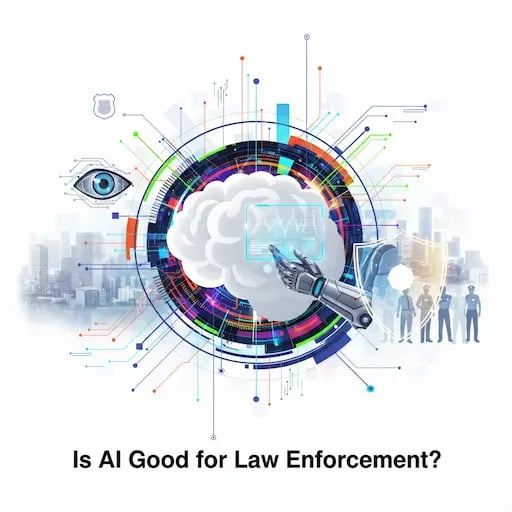
The honest answer is: it depends on governance.
AI does not replace officers but augments them. Searches like “Can AI replace police officers” reflect fear, but in reality, AI handles data while humans make decisions. The danger lies not in the technology, but in unchecked deployment without ethical oversight.
This is why AI law enforcement policy debate and AI policing ethics research are growing fields in 2026.
Real Incident That Sparked Debate


In one widely discussed case, an AI facial recognition system misidentified a man as a theft suspect due to low-quality footage. He was detained briefly before human review cleared him.
Impact: The incident triggered national discussion on AI policing risks and dangers.
Outcome: Mandatory human verification was added before any detention based on AI alerts.
This case became a reference point in AI law enforcement news and policy reform discussions.
Where the World Is Searching the Most
United States: Interest in predictive policing, ethics, and AI law enforcement tools.
United Kingdom: Focus on AI police surveillance and chatbots.
India: Growing searches around AI policing and public safety tech.
European Union: High concern around facial recognition and regulation.
Global English regions: Continued curiosity about whether AI policing is helpful or dangerous.
Conclusion – Helpful or Dangerous?
AI in policing is neither hero nor villain. It is a powerful tool. In the right framework, it improves public safety. In the wrong hands, it threatens privacy and civil liberty.
The future of AI in law enforcement will not be decided by engineers, but by lawmakers, communities, and informed citizens.
🔗 Related Reading
Read our previous article: AI Surveillance Ethics: Are We Being Watched by Machines?
Upcoming article: AI Job Replacement 2026: Is AI Replacing Humans at Work?
Frequently asked questions
Q1: What is AI policing?
AI policing refers to the use of artificial intelligence for crime prediction, surveillance analysis, and operational support in law enforcement.
Q2: Is predictive policing accurate?
It depends on data quality and oversight. Without checks, it can reflect past bias.
Q3: Does AI replace police officers?
No, it assists them with data and pattern recognition.
Q4: Is AI facial recognition legal?
Laws vary by country and are rapidly evolving.
Q5: What are the risks of AI in policing?
Privacy invasion, bias, and misuse without regulation.
Disclaimer
This article is for educational and informational purposes only. It does not promote or oppose any law enforcement technology but aims to present balanced insights.
Follow & Subscribe to The TAS Vibe
If you found this article informative, follow The TAS Vibe for deep insights into AI, privacy, ethics, and the future of technology.
Author Bio – Agni
Agni is a technology writer passionate about explaining complex AI topics in simple language. He focuses on AI ethics, surveillance, and digital privacy. His work bridges the gap between innovation and public awareness. Agni believes informed readers make better decisions in a digital world. He writes for global audiences across America, Europe, Asia and beyond. His articles combine research, clarity and real-world relevance. Agni regularly explores how AI is shaping society in 2026. Through The TAS Vibe, he aims to make technology understandable for everyone.
Subscribe to our Blogging Channel The TAS Vibe
Connect
Stay updated with us
Follow
Reach
+91 7044641537
Copyright: © 2026 The TAS Vibe. All rights reserved.